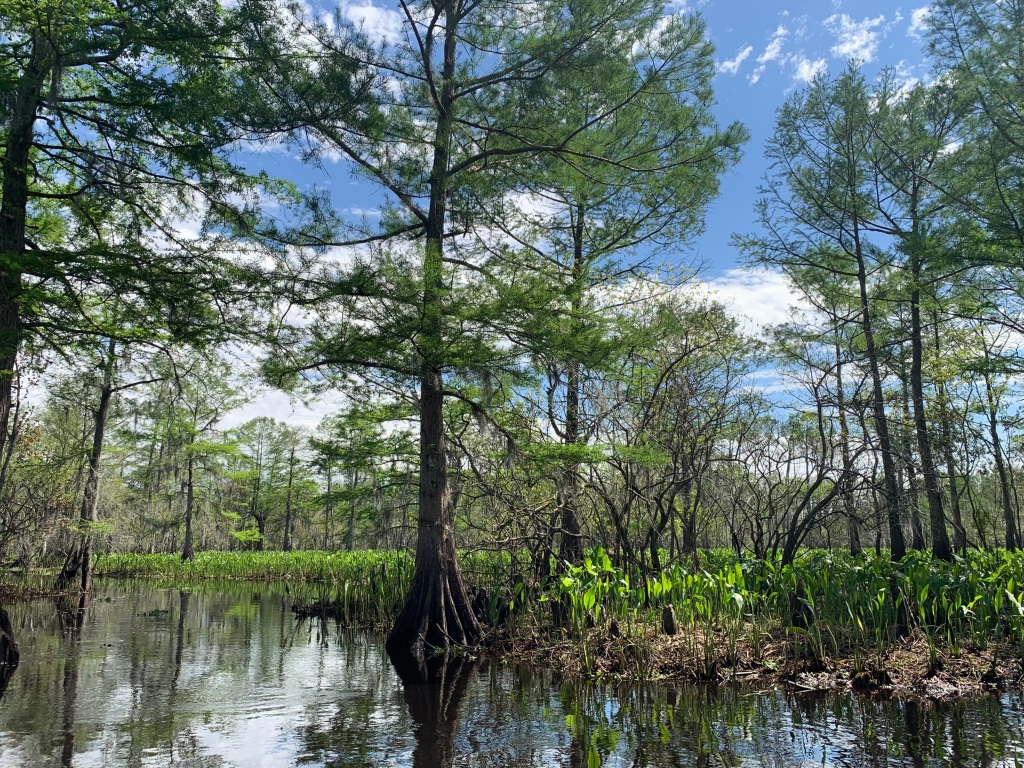
This campground, a wildlife paradise near New Orleans, was the turning around point for my journey.
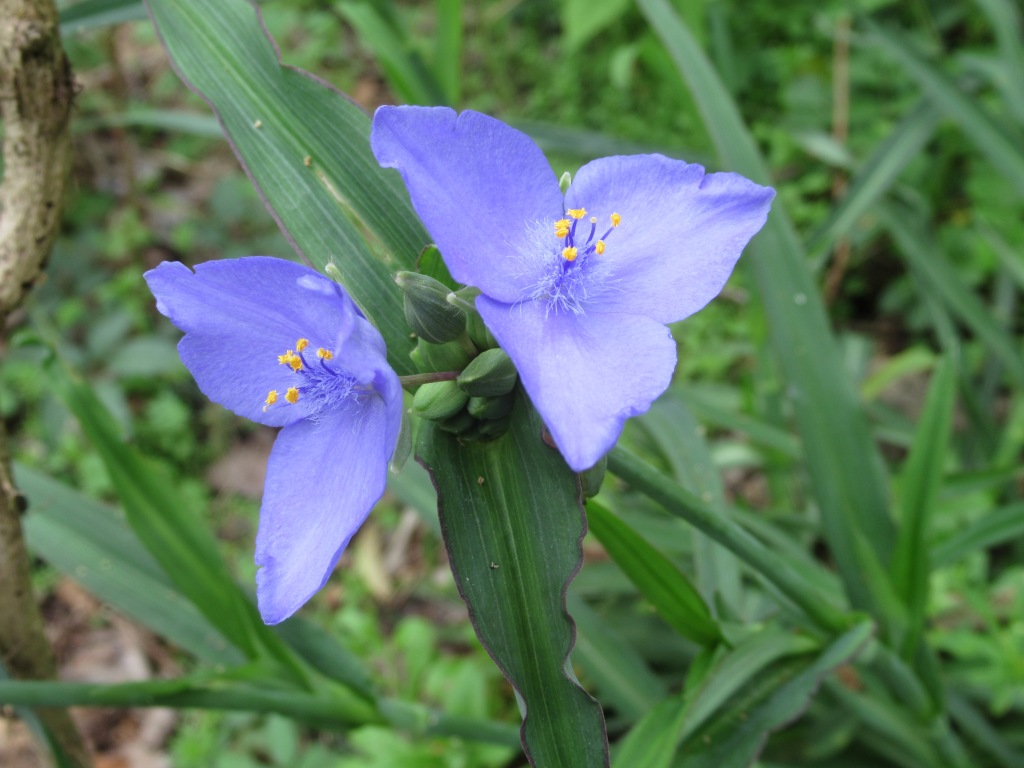
Spiderwort burst into bloom during my 12-day sojourn.
I left Louisiana this morning, to begin my long journey back to Maine. It was sad. For this “62-plus” solo RVer, St. Bernard State Park was the perfect campground (except for the fire ants). With the senior discount, the cost for my water and electric site was just $14 per night. I also lucked out with a long green space that led back to a busy wetland full of wildlife. There were hot showers, an on-site laundry, and it was an easy 18-mile drive to the French Quarter. The main road near the campground goes straight into New Orleans and becomes Rampart St., with parking readily available.
My backyard wildlife list included a red-eared slider, little blue heron, alligator, raccoon, and a pair of yellow-crowned night herons, as well as the almost hourly call of the barred owls.
Best of all was time with friends – Sue and Roy, my camping neighbors from Blythe Island in Georgia, and Al and Ingrid, who I met here in the manner I often do, when Al came over to guide my backing up. I am improving, but I don’t want to get so skilled that I no longer make wonderful friends this way!
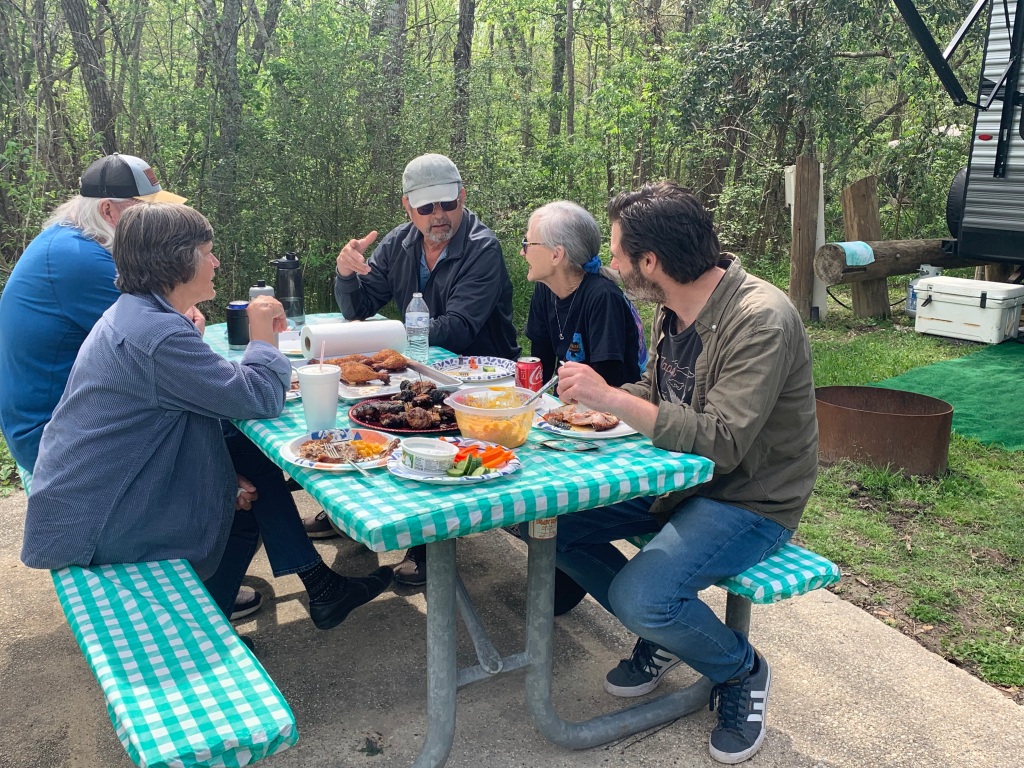
Al’s smoked chicken quarters and deer wraps with bacon made for a fine picnic!Roy provided much needed moral support for my refrigerator repair. I miraculously discovered the problem (a blown thermal fuse), thanks to advice on the Grand Design owners’ forum. Young alligators in the lagoon beside the state park’s nature trail. There were seven that day, all the same size, in one small area. Later, I would return with Sue to find a huge mother alligator in the same spot, with foot-long babies sunning on her back.Sue, Roy, and I took a four-hour guided kayak tour of the Manchac SwampA non-venomous Mississippi green water snakeRoy and Sue in their canoe, with shrimping boats in the background. We explored the salt marshes of Bayou Bienvenue yesterday. After all the meals and rides and campfires they’ve shared with me, it was fun to show them the abundant birdlife, especially a gorgeous pink roseate spoonbill.
Meeting aome intriguing inhabitants of a tributary of the Conecuh River
After anxiously stalking back and forth in the woods with a repetitive clicking call, this limpkin decided I was alright and strutted and posed for quite a while.
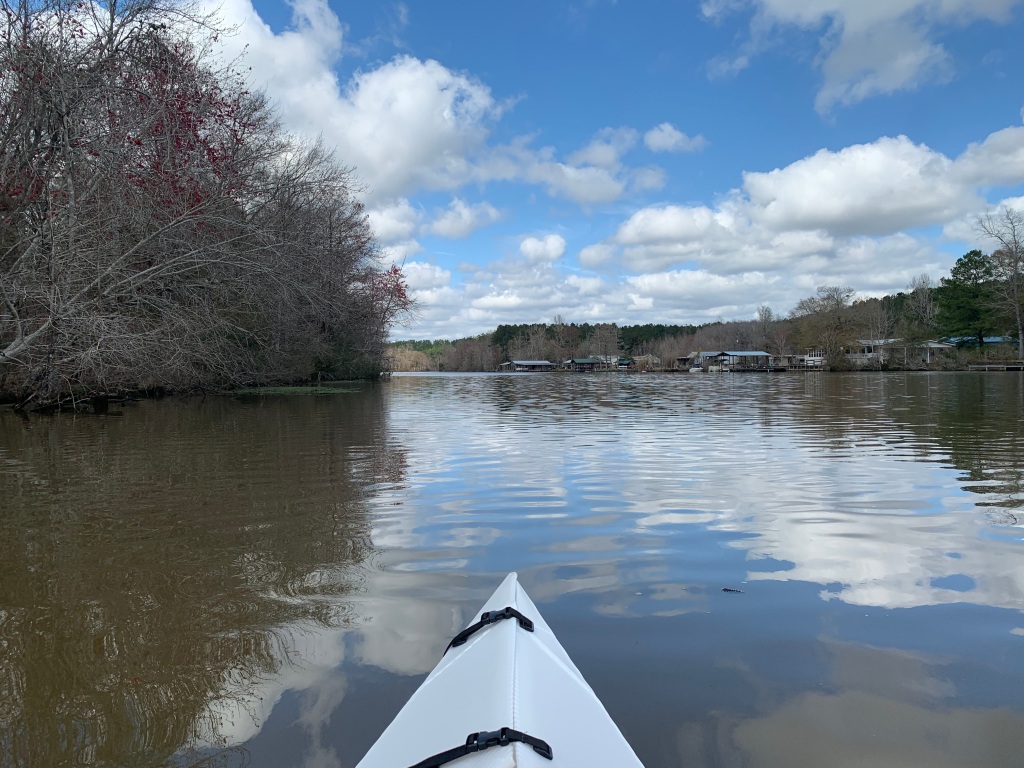
I love stumbling upon an experience purely by chance. In searching for a laundromat, I noticed a sizable body of water north of Andalusia, Alabama. Certainly, it was more substantial than the tiny, mostly spring-fed sinkhole ponds of the nearby Conecuh (cuh-NECK-uh) National Forest where I was camping. After laundry and worship at the Southside Baptist Church, I found the boat launch and a friendly bass fisherman also launching. “That way, it’s all river,” he pointed out, “just watch out for moccasins. There are plenty of them up that way.”
It felt refreshing to be on moving water again. I assumed this was the Conecuh River, which was impounded to create Point A Reservoir, just below. Turns out I was on a tributary of the Conecuh.
I calculated the current at about half a mile an hour, upstream first, just the way I like it. The limpkin called my attention with a strange, unfamiliar, piercing call that no one could miss, then segued to the clicking sound while walking. There were also many turtles out in the on again, off again sun.
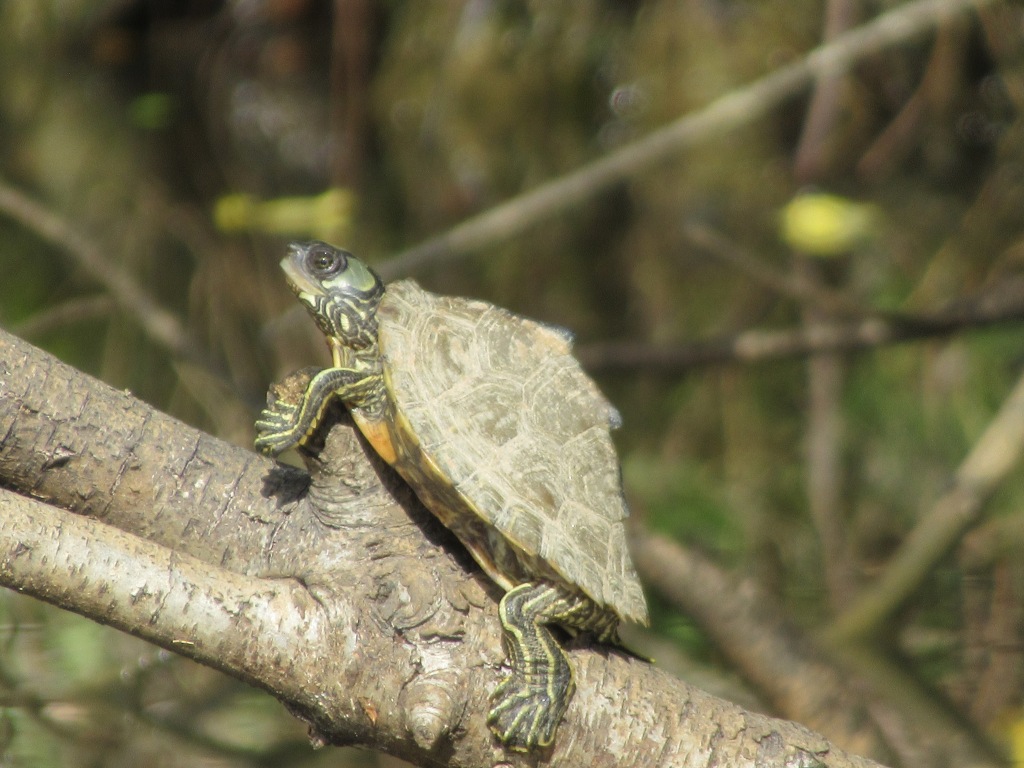
I’m still working on identifying this small map turtle. I saw many of these individuals with two distinctive bumps on their peaked shells, often clinging to steeply slanted branches.The friendly bass fisherman mentioned duck hunting up a little side creek, so I ventured up into this cypress swamp, where I quickly reached a dead end guarded by hungry mosquitoes.
I’ve been using my Garmin Etrex 30 handheld GPS on these paddles to measure distance. This out and back was a little over four miles total, with an average moving speed of 2.0 mph. I’m naturally a slow paddler who spends a lot of time drifting to look at and photograph my surroundings. For those of you keeping track, I now have about thirty-five miles on my new Oru Lake kayak.
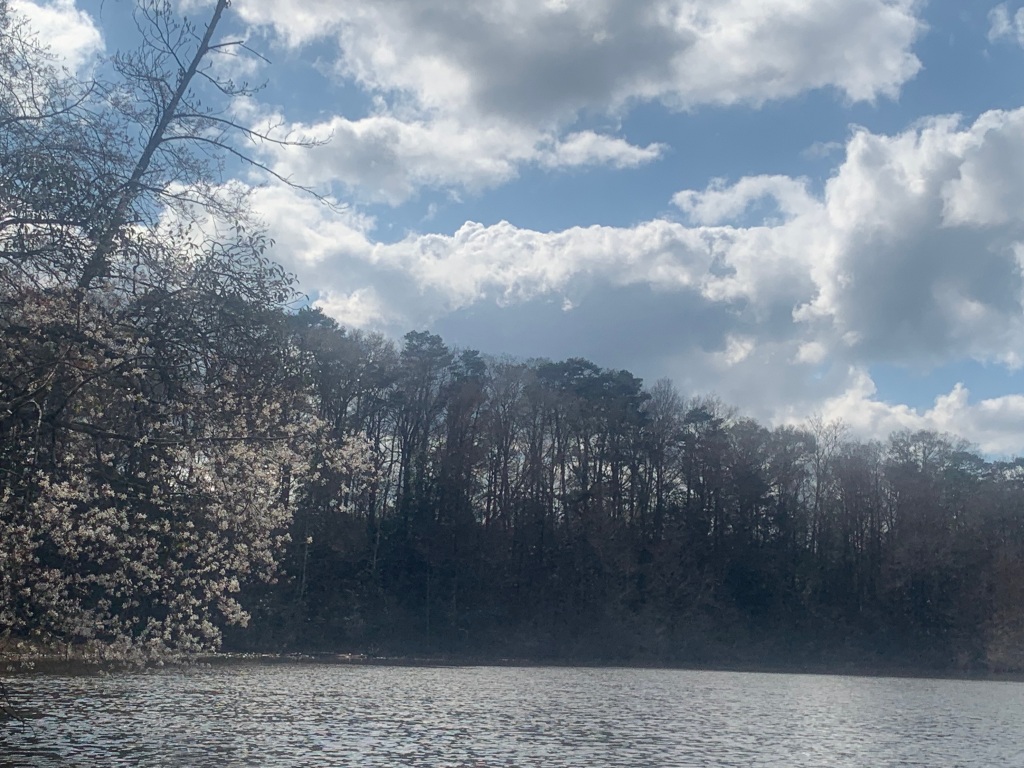
One of many flowering trees announcing the start of spring in Alabama. This one was a species of serviceberry or shadbush, perhaps downy serviceberry. This is the map I had to work with, an example of the drawbacks of embracing a spur-of-the-moment adventure. I launched at the upper #1, and the creek that I paddled up is not labeled.
A Civil War battlefield, The Florida National Scenic Trail, and kayaking Ocean Pond among giant cypress
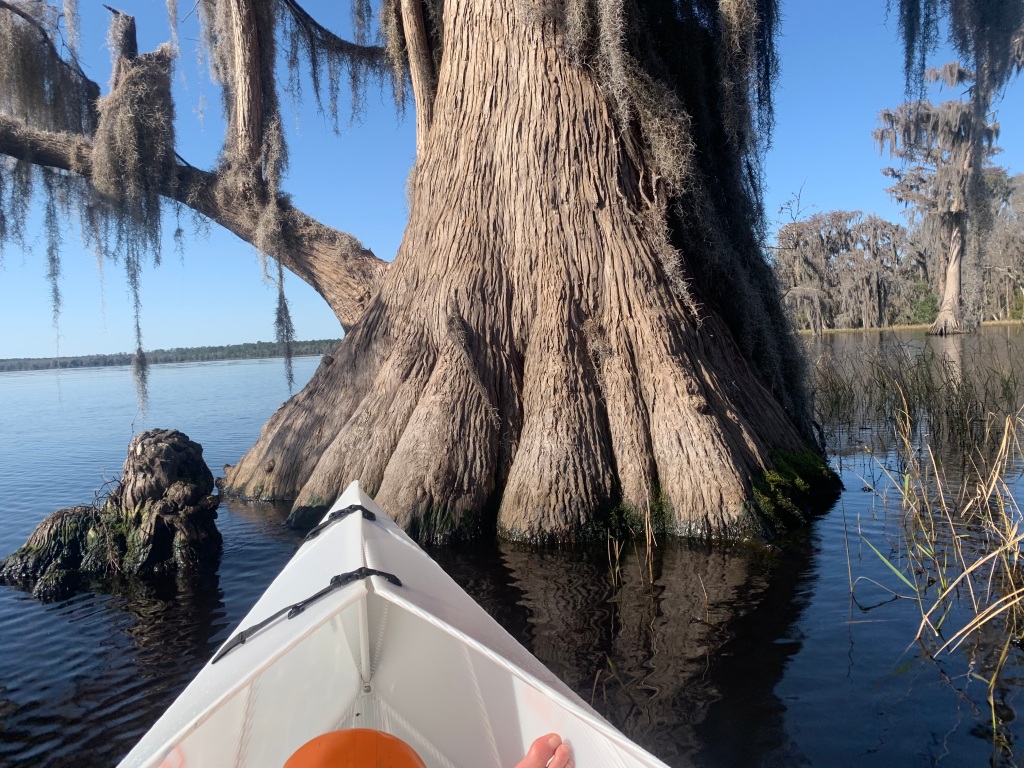
Paddling among giant cypress on Ocean Pond
Before sharing about Florida, I have to tell you that I have now astoundingly joined the ranks of DIY travel trailer fixer-uppers. (Although nothing is fixed yet). Much of this cold and rainy Alabama day has been devoted to trying to figure out why my refrigerator is not working. From the simple checks-breakers, fuses and plugs-I moved on to trying to secure a dealership repair appointment (impossible) or a visit from a mobile RV tech.
The closest tech turned out not to be close anymore as he now lives in Arkansas. But Ron was the best of trail angels, spending hours helping me over the phone. There I was with my multimeter, in the land of circuit boards, colored wires, and hidden fuses. Finally, through a Grand Design owners forum, I discovered a blown thermal fuse that I will soon try to repair. What a learning day!
Site #28 in the Ocean Pond Campground only had a water hookup. However, the generator and solar panel kept me up and running, all but the refrigerator. I sure was looking forward to having cold and frozen food in the campsites ahead, all of which have electricity.
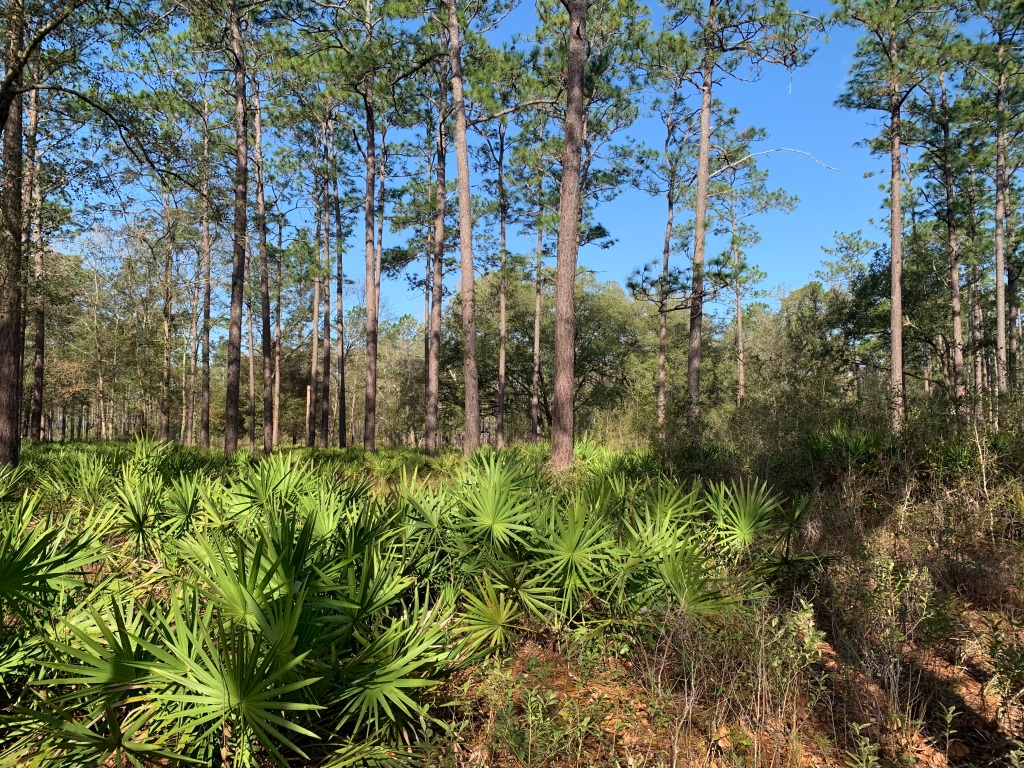
The largest Civil War battle to take place in Florida was fought nearby. The Olustee Battlefield Historic State Park was seven miles from camp. Interpretive panels along a one-mile trail told the story of the evenly matched battle through photographs, primary sources, and a clear narrative. The terrain of open pine woods and palmettos, interspersed with impassable swampy areas, helped me visualize the drama of that tragic day. Just over five thousand soldiers on each side-the Union hoping to cut off food supplies from Florida at the Suwanee River railroad bridge and the Confederates handing them a costly defeat.
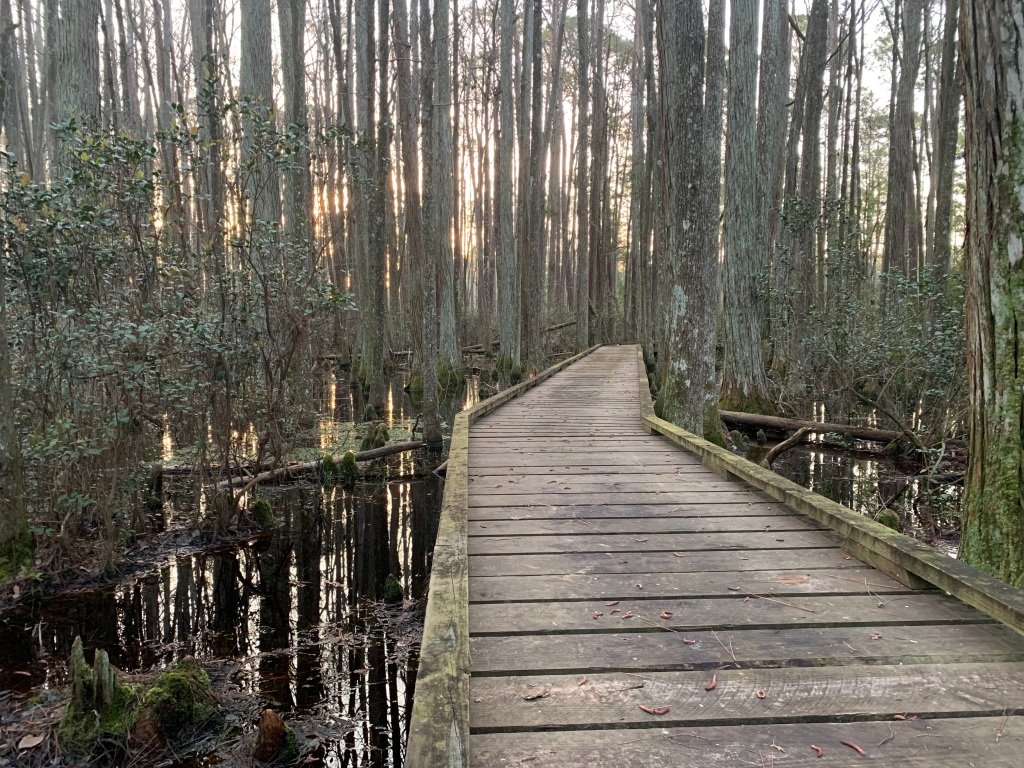
“Grape and canister swept by with hideous music, and shell after shell tore through our ranks and burst amid heaps of our wounded heroes,” remembered a soldier of the 115th New York.Huge crowds attend the re-enactment of the battle every Presidents Day weekend.Boardwalks are becoming a favorite haunt of mine. This one, through a cypress swamp on the Florida National Scenic Trail, enticed me to sit and write and study the verdant plant life.A native green anole (I think) at the edge of the cypress swamp. Anoles, like chameleons, can change color. In Florida, over two-thirds of the lizard species are invasives, including the brown anole, which arrived on cargo ships in the late 1800s. Females of both species look like this one.
Ocean Pond is the roundest body of water I have ever seen. One day, I kayaked around its almost 7-mile shoreline. The shallows near shore are picturesque, with turtles and water lilies among the cypress. I studied one patient great egret who was fishing there, swallowing his catch with bounces of his very long, thin neck. There were patches of pickerel weed, not yet in bloom, and cow lily (spatterdock) just beginning to show its bright yellow, spherical flowers. I love the touches of home to balance out all that is new and unusual.
The border of grass behind me was present almost all the way around the lake and often prevented me from accessing the shallows, except where there were openings. Knowing that there were alligators around and it was a warm day made me cautious to plow through the grass and reeds.
I’ll finish with a shout out to the federal government for their America the Beautiful Lifetime Senior Pass, available to those 62 and older. For a one-time cost of $80, mine has already paid for itself two times over since I purchased it on January 5th. How grateful I am to be experiencing all these natural wonders at such an affordable price!
A community service opportunity for me and my folding Oru kayak
My folding kayak and I had tiny Macedonia Lake all to ourselves
The people of South Carolina were warm and friendly, helpful and welcoming, but they were also few and far between. The trail angel prize goes to an empathetic guy at a local YMCA, who must have sensed my desperation over the phone. Although there was no day pass option there, he generously offered to let me shower if I showed up before his shift ended. The copious hot water was the best! The congregation at the Fairview Baptist Church, several propane tank fillers, a waitress, and a highway worker ensuring I wasn’t lost rounded out the list of human contact for an entire week. (Unfortunately, the highway worker did not appear on the occasion that I was actually lost).
Consequently, the young man who cruised into the Brick House Campground on Sunday afternoon was a welcome visitor. His question about my solar setup soon evolved into a lengthy chat covering everything from local seafood specialties to the benefits of solitude. When I asked if he did any fishing (still thinking about those giant catfish), he recommended a visit to Macedonia Lake. This small waterbody, located about seventeen miles north of the campground along the Palmetto Trail, is also accessible by road.
Ready to explore tiny Macedonia Lake
As I was planning this winter’s journey, I thought a lot about how to interact with communities along the way. One thought was to participate in some community service events. I almost connected with one at the Fairview Baptist Church. They had an ambitious Brunswick stew fundraiser coming up, but I would be already gone when the day came to peel all those potatoes.
At Macedonia Lake, I discovered a project just as beneficial.
Evidence of an active beaver population
So, let’s talk trash…garbage, refuse, litter. With special emphasis on bottles, cans, fishing line, foam cups, bait containers, bobbers, and empty chip bags. Although cleanup crews are making a valiant effort along the highways of the South, the amount of trash in the water is appalling. It makes me sad, and also reinforces my gratitude for the cleanliness of our northern waters. At home, I might snag one wayward beer can or water bottle in hours of canoeing.
In the south, the sheer volume of trash I had seen so far was overwhelming. Macedonia Lake was no exception. After cruising the shoreline (a quarter hour of slow paddling) and sitting for a while to listen for birds, it didn’t seem like much of an accomplishment. Until I thought of trying to pick up all the trash that I could reach from the kayak, counting items as I went. Luckily, I found a trash bag and plastic gloves in my pickup.
The black bag was already full and had been left at the boat launch.
I did not by any means get all the trash. Despite some tight maneuvering and teasing bottles and cans towards me with the paddle, I left a fair amount behind. Plus, the far shore had its own boat ramp peppered with trash that I did not have room for in the kayak. My count stood at 45 items when I’d made the shoreline circuit once again. Some bottles had obviously been there for years. Long enough for countless people to have done what I was doing. To round out the day, I gathered more than 55 more items from the boat ramp area in just a few minutes. What were people thinking?
A week later, at the Georgia Sea Turtle Center on Jekyll Island, a display would remind me of the time it would take for some of this trash to degrade: monofilament fishing line (600 years), the wine bottle I found floating in the lake (undetermined), foam cups (50 years), plastic bottles (450 years), and aluminum cans (80 to 200 years).
Usually, I try to end my posts with a pretty picture or a positive thought. Today, I just want to encourage each and every person who sees trash like this to pick up some of it. Simply that. Leave our natural world cleaner than you found it.
A wildlife bonanza and kayaking serendipity right at camp
This campground, part of a park run by Glynn County, was my home for three nights, arriving January 23rd and departing January 26th. After the long excursion to Okefenokee, I decided to stay and enjoy the park on my last day. Chores and writing got accomplished, but I also just relaxed. While my laundry was drying in the laundromat, I walked over to the park’s public marina on the tidal South Brunswick River. The birds, there, oh my, I just couldn’t believe it!
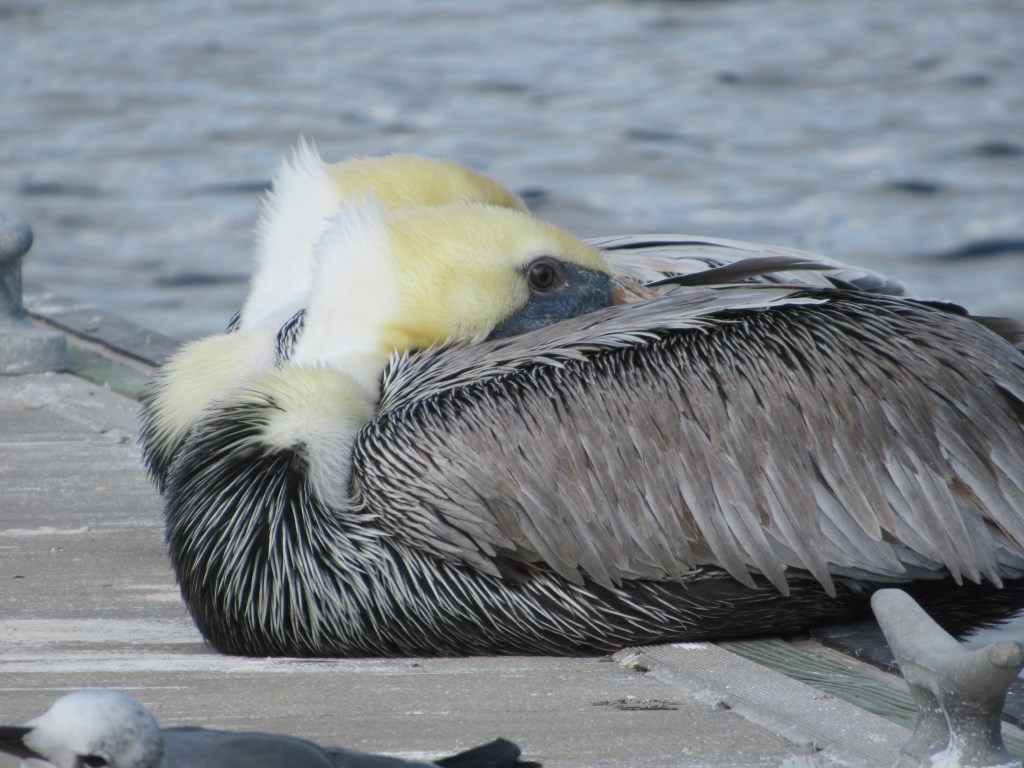
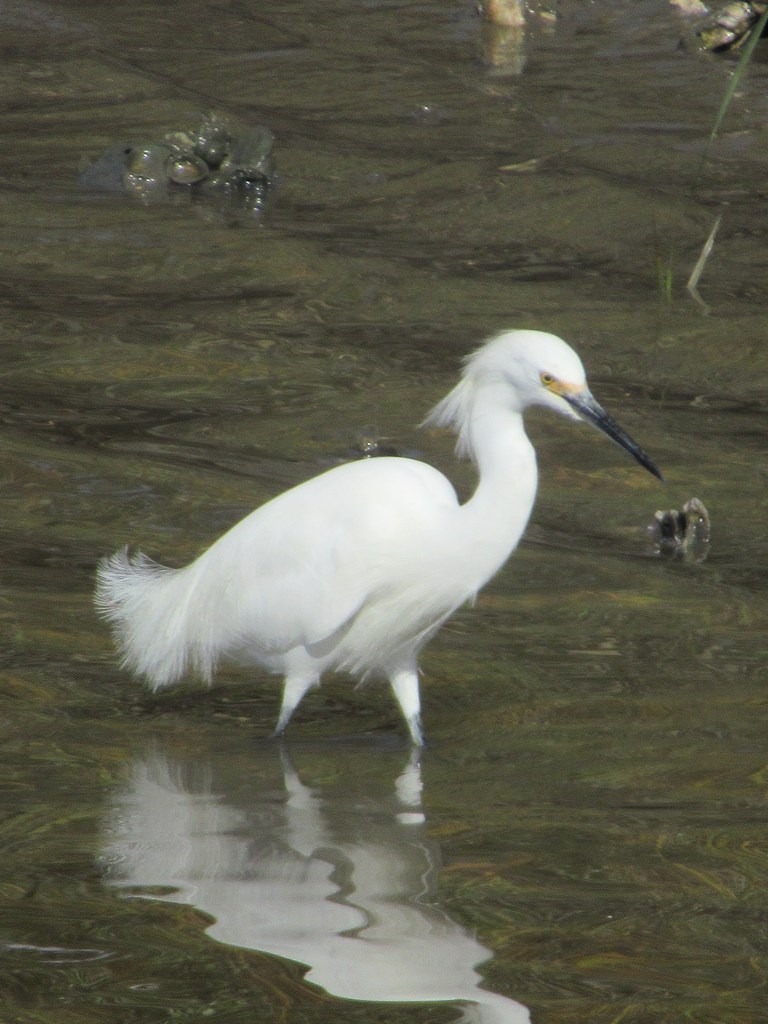
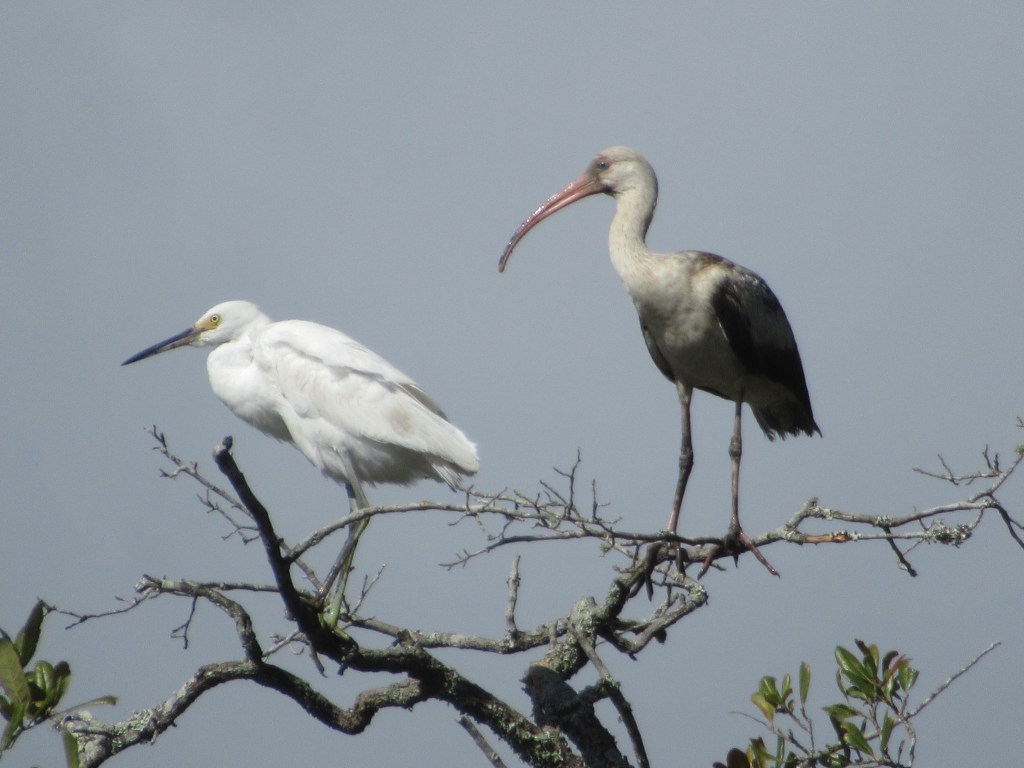
On the dock, a pair of brown pelicans posed willingly, their fuzzy yellow heads so soft in contrast to their much coarser gray body feathers, wet from the brackish water.Another intriguing poseA male hooded merganser popped up next. I watched him dive and preen, gazing down from behind a long fish cleaning table that mostly hid me from sight. The snowy egret can be identified by its bright yellow feet, which I clearly saw as he stalked along.Then there were these buddies. The immature little blue heron on the left, with its distinctive green legs, flew in first. Then came the bird on the right, which I believe is an immature white ibis.Two youngsters enjoying the hot sun and refreshing breeze, hanging out together.
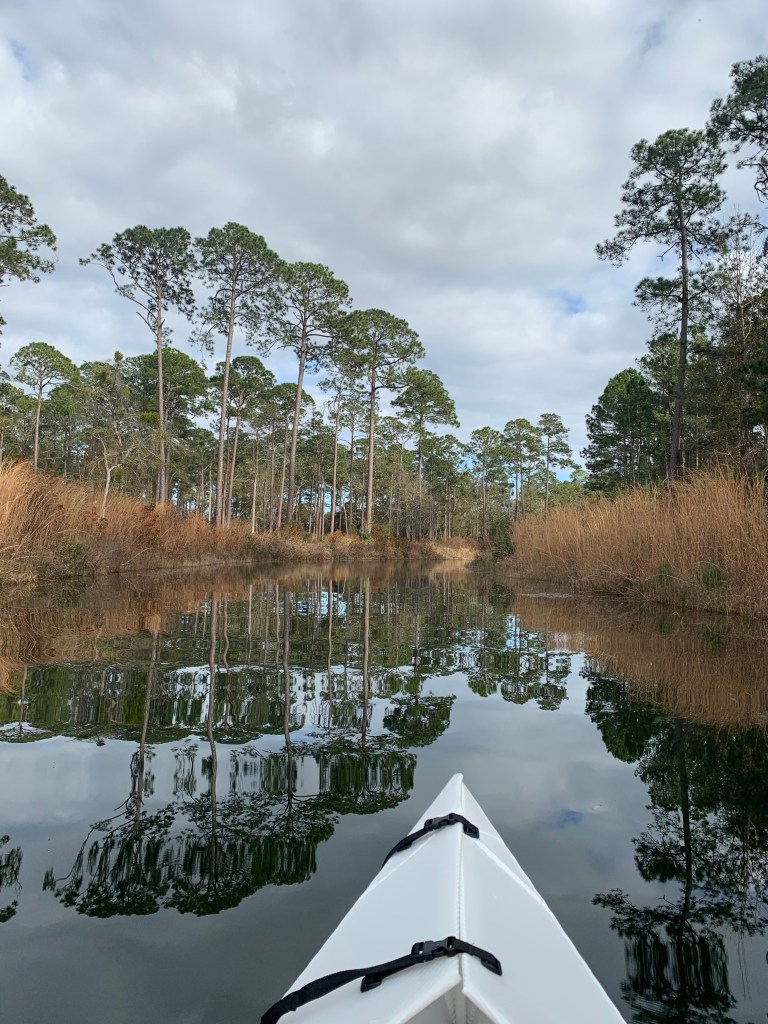
Later that afternoon, I ambled out of my camp chair, assembled the kayak, and plopped it into the water that I could see from my front window. There are two tiny lakes there, but it turns out there is a canal (or stream?) that flows out the far side. Paddling past more egrets and a shy turtle, I followed the current into the narrow passage, past longleaf pine above and rhododendron below. Once, I turned back briefly just to make sure that going against the current would be doable.
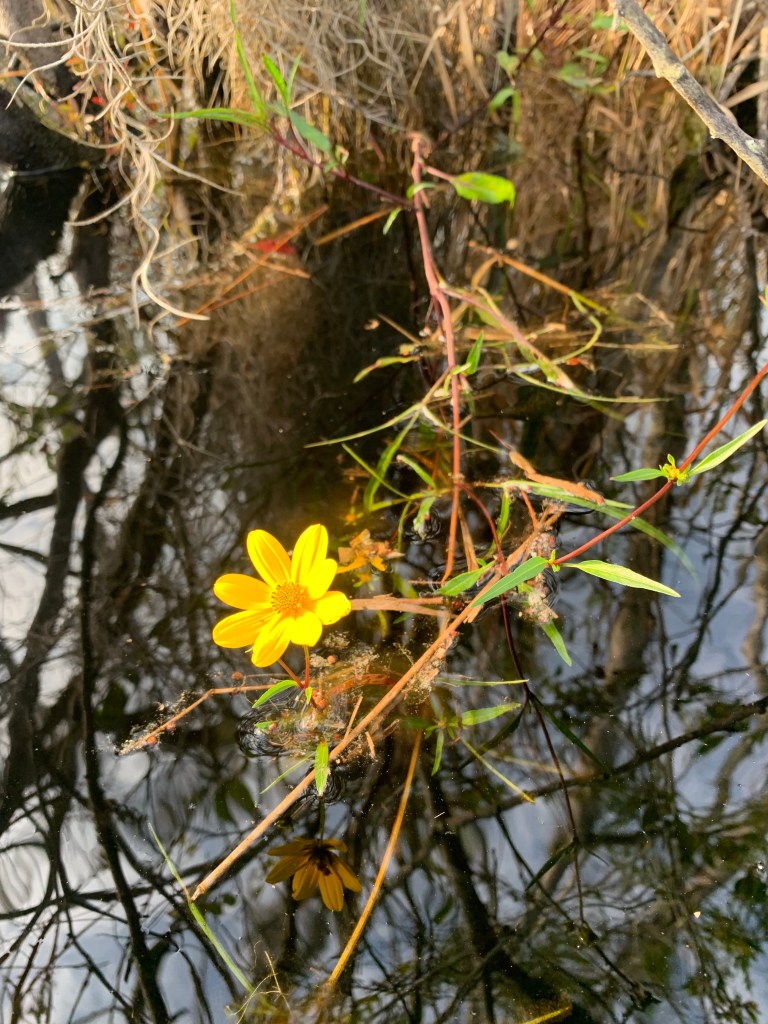
If I hadn’t stayed to relax at camp, I would have missed this gem.Today’s mystery water plant, observed in several large matted clumps
Exploring that canal and a couple of dead end turns off of it, I ended up paddling almost three miles. Meanwhile, there was a small problem in paradise. Fires ants! Carrying the kayak down, I had been bitten four times. I recognized that stinging pain right away, but it took a minute to find them under my Teva strap. A day later, my left foot would be swollen and very itchy, with blisters where the bites were and an ugly reddish color to the front half of my foot.
I will spare you a photo of that!
Last character of the day’s wildlife bonanza was this armadillo, spotted as I drove back home with a takeout shrimp po boy from Fish Tails Pub & Grill, right down the road.
Thrilling encounters with my first alligators while paddling my Oru folding kayak
Some stories need to be told right when they happen! Between North Carolina and here, I spent six nights off-grid in the Brick House campground in South Carolina’s Sumter National Forest. I’ll get back to that sojourn, which featured frigid temperatures, an ailing generator, and hiking the Palmetto Trail, later.
This 630-square-mile wildlife refuge includes the majority of the Okefenokee Swamp. The refuge’s main entrance is located off Route 121 in Folkston, Georgia.
Struggling to back my trailer in just where I wanted it was the perfect way to meet my backyard neighbors at the Blythe Island Regional Park campground in Brunswick, Georgia. Roy came over to quietly advise me and his wife Sue soon followed with information about some canoeing they’d been doing. The water trails at the wildlife refuge were a true discovery, and I knew I had to go explore them. Roy and Sue had seen and heard flocks of sandhill cranes and showed me photos of the Suwannee Canal, which begins at the visitor’s center.
Spanish moss drapes water-loving cypress along the shores of the 1891 canal
At the visitor’s center, I scooped up some fabulous free stickers for my growing collection and got an orientation to the water trails. As I had to be off the water by 4:30 p.m., I would do the length of the canal and back, around four miles, but would not get to explore any more of the water trail system.
How long has it been since I’ve seen a flower blooming?
The startling news was that lots of alligators had been seen basking in the sun on this 70-degree day! You think I’ll get to see one? I asked in surprise, as much excited as apprehensive. Oh, there’s no doubt, replied the ranger. He then assured me that alligators are not aggressive, and you can paddle to within fifteen feet to photograph them. Most of the time, in January, alligators are in brumation, a type of torpor where heart rate and metabolism slow down. On warmer days, though, when you start seeing turtles out, snakes and alligators will also be active.
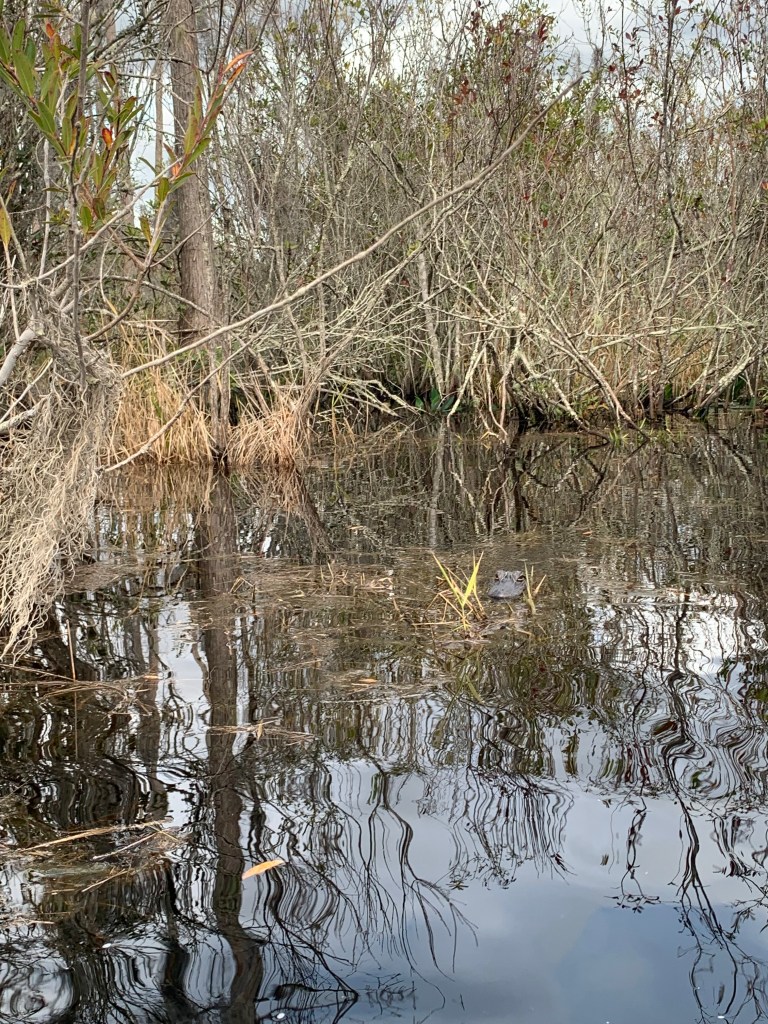
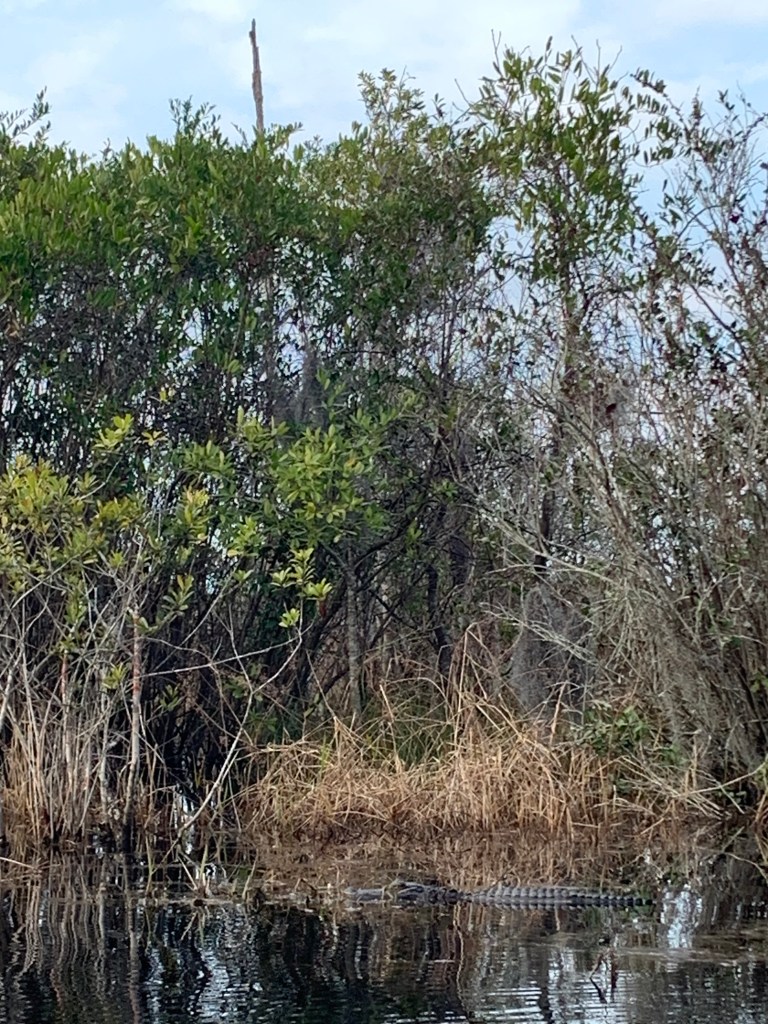
Every sense was on alert as I scanned the banks. In addition to reptiles, I was on the lookout for river otter or the elusive American bittern, both of which had been spotted today. The alligators would be sunning on the banks. I probed the tall dry grass and peered into the water under shrubby brush. Finally, a shape emerged, like jagged teeth…an alligator tail. It was a big one, and looking closely, I could see his body and head, facing away from me. The wind pushed me away, until trees hid his form. I paddled back again and again, not really believing that here I was in my little folding kayak communing with a gator!
Some of the big fellows were hard to spot. This one is tail first straight ahead of the kayak.
In two hours, I spotted eleven, four going out and seven coming back, so perhaps there were repeats. As I learned what to look for and where, they were easier to find. Two acknowledged my presence: a large one that slowly sank until only the top of his head and eyes were visible and a small one that twisted into the water with a big splash when I got too close. That was creepy, to have him somewhere underwater, not too far away!
Keeping an eye on each other!
My only regret was that I couldn’t stay longer and explore more. The refuge is home to flocks of white ibis and wood storks, as well at the sandhill cranes that Sue and Roy witnessed. Fifteen species of turtles make their home here. Perhaps someday I will return, to paddle farther and hike some of the trails as well.
How my new origami kayak performed in some small coves on a very large lake
Every great blue heron seems unique. This one had marvelous feathers and a calm presence.
Before jumping into the report of kayaking Badin Lake in my new boat, I want to share that life out here is not always rosy. I’m in South Carolina now, and last night was cold, lonely, and edgy. A true test of camping totally off-grid in frigid conditions. I wanted to try this, and I’m discovering that a lot of effort goes into cleanliness (laundry and even showers, as the camper is still winterized) and maintaining enough battery power to have light and warmth. This morning, I woke to an outside temperature of 13, after a night in which I had to switch propane tanks at 2 a.m. and then lost battery power at 4:30 a.m., an hour and a half before generator use is allowed. But it’s warm and cheery in here now!
Assembling the kayak from folded suitcase to finished product is down to nine minutes
In asking for questions, it’s evident you want to know how the boat handles. My first two significant outings were on 5,350-acre Badin Lake, launching from the Cove Boat Ramp adjacent to my campground. After tying a line onto a bow strap, I stepped in from the dock. From the first moment, the boat felt very stable. A huge positive, along with its compact folded size, light weight, and portability. A boat that’s easy to get ready gets used more.
A friend has likened it to paddling a box, and in some respects, he is not far from the mark. I went out twice and found that my paddling technique improved with experience, as I adjusted to a much shorter, less dynamic craft, where I am not up on a seat. Even in small, choppy waves, I felt secure and angled into them as I would have in my canoe.
This was my favorite nook, where it almost seemed I would find a shortcut to the next cove. Maneuvering around logs and weeds, I was pleased that the boat responded in a familiar way.
Another drawback is comfort, or should I say discomfort? After a couple of hours on the thinly padded seat, I found myself wiggling and stretching to try to get comfortable. Loosening or tightening the side straps to adjust the angle of the seat’s back rest helps, but not enough. There is also no foot rest or bar to brace against. My back and bottom were very stiff when I clambered out onto the dock after the longer three-hour excursion.
Mosaic of sun and cloud above the beautiful wooded shore
Most of all, it just felt wonderful to be back out on the water. I saw lots of wildlife, including a painted turtle sunning in January, belted kingfisher, buffleheads, cormorants, herons, downy woodpecker, and a large dark hawk I could not identify. There were moments when the cadence of the paddle felt just like old times. Somehow, this seemed rather miraculous in this unique boat.
To read more about the sights on Badin Lake, look for my March column in the Northwoods Sporting Journal. Issues become available on the NSJ website shortly after publication.
Introducing the new, lightweight, folding Oru Kayak that’s joining me on my winter RV travels in the South
At first, I planned to bring my 13-foot solo canoe along on this winter’s RV travels. The more I thought about it, though, the more I wished for a more compact boat. Well, it doesn’t get much more compact than a folding kayak. Folded up, it resembles a suitcase, complete with handle. It fits easily inside the truck’s back seat area. You can even fly with it as luggage!
My Lake model Oru Kayak at Maine’s Biscay Pond after its first short outing
Made in the USA, Oru kayaks come with a 3-year warranty. The material they are made of reminds me of post office mail tubs. The 5-mm, double-layered, polypropylene sheet is not flat. The bow and stern are partially shaped and have small hard plastic caps. The boat comes with pre-marked fold lines, but getting it assembled the first time was not an easy task. Even now, considerable effort and force are needed to pop the folds in and out.
Awfully chilly on my bare feet getting in and out on a Maine lake on December 15th!
As I travel South, the waters will be warmer and the excursions longer. My kayak, the Lake model, is the newest, lightest (18 pounds), and plainest of the Oru kayaks. It is easy to carry, ensuring that I will use it often.
There are still uncertainties ahead. How will it track and handle in wind and waves? Will it always feel as stable as it did when I hopped in the first time? Dare I paddle it where there are alligators? All this and more will be answered in the coming days and months.
To learn more, look for my column, “View from the River,” in the upcoming February issue of the Northwoods Sporting Journal. It’s all about the boat.
Ringing in 2024 with the news that a new adventure is beginning, a winter of RV life in the South!
First night on the road at the Danbury, CT welcome center
New Year’s Day 2024 is an excellent time to let you all know about my brand-new, months-long winter adventure. I left Maine on December 20 pulling my 2020 Grand Design Imagine XLS 17MKE camping trailer with my 2017 Ford F150, which still has not turned 50,000 miles on the odometer.
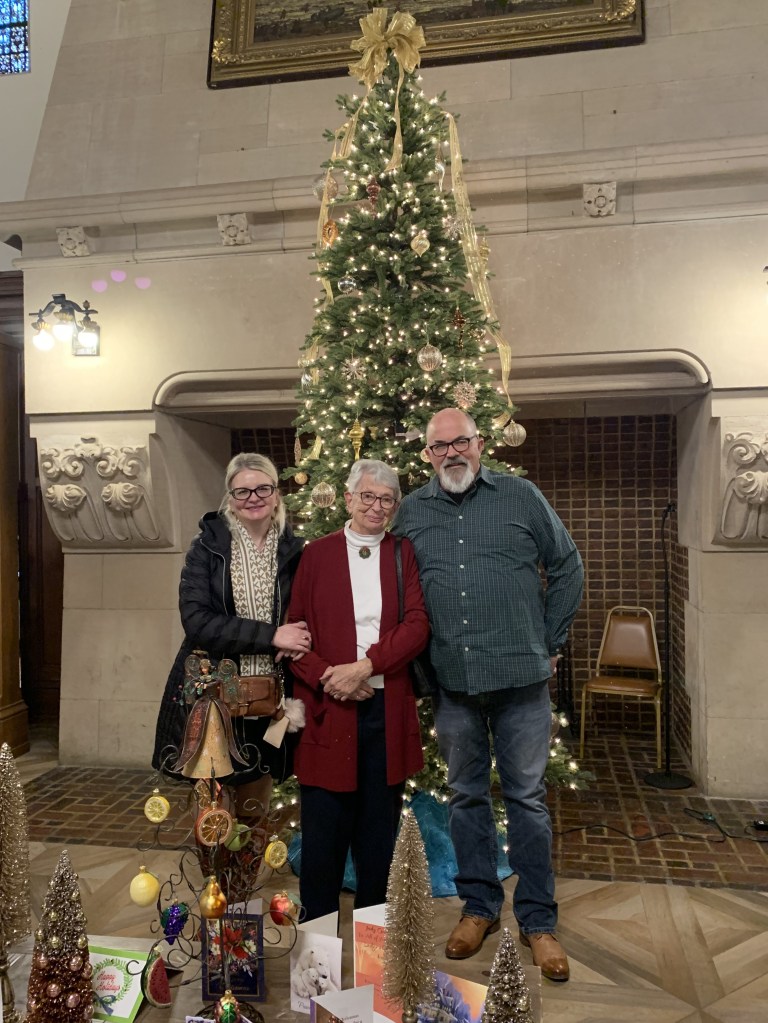
Mila, Mom, and Greg after Christmas dinner in the Masonic Village Grand Lodge
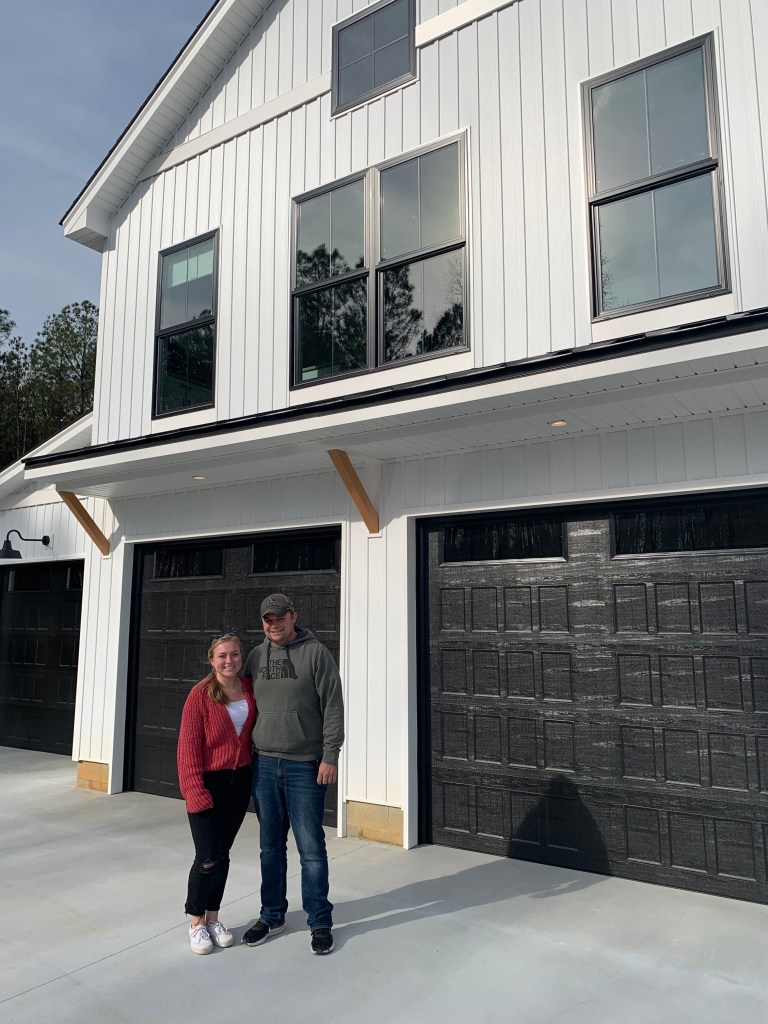
Two days and 630 miles later, I arrived at the Masonic Village in Elizabethtown, PA. I had reserved a spot in the RV parking lot here, where residents store their RVs and family members can temporarily park while visiting. My parents’ cozy apartment would be home base for almost two weeks in between family trips to VA for my son’s 30th birthday and later to celebrate Christmas. Taylor hosted us for brunch and a tour of the home he recently built on the family farm where he is the fourth generation working the land.
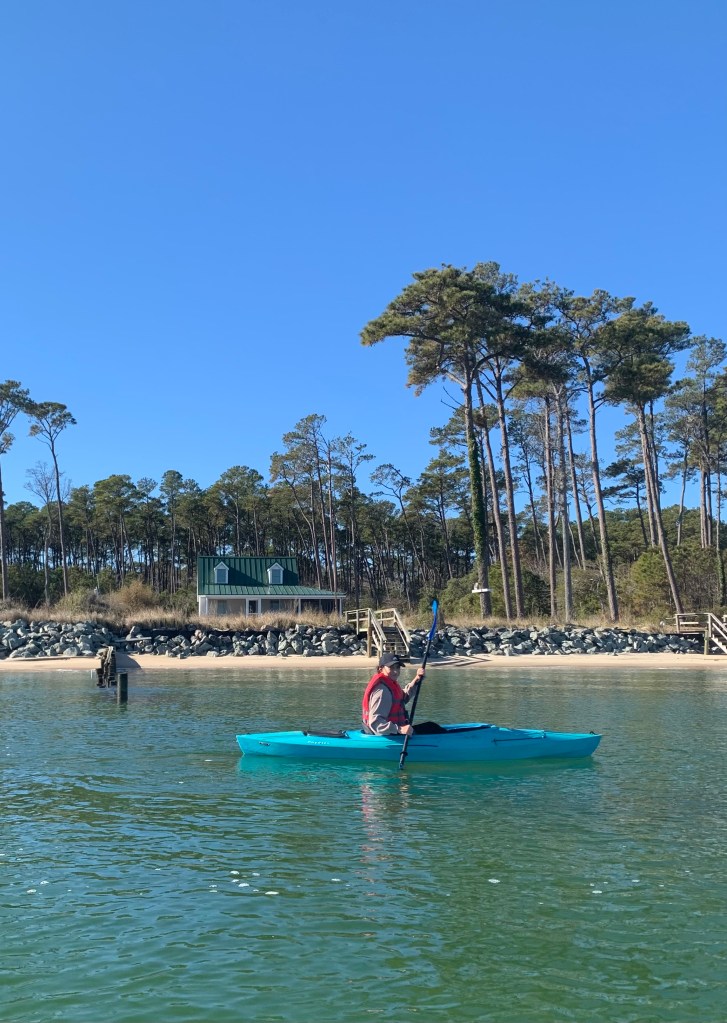
Our Airbnb on Gwynn’s Island in the Chesapeake Bay came with two kayaks. The warmest, calmest hours were just warm and calm enough to enjoy cruising the shore. Megan spotted a plum-colored jellyfish jetting through the clear, cold water, propelled by a host of delicate, translucent tentacles.
Of course, the best part of the last couple of weeks has been the time together: sunny adorable Millie enjoying her first Christmas, the conversations and food, the traditions old and new. There could be no better beginning to my journey.
In past years, the only option for renting a kayak here was a double sit-on-top style, which Megan and I used two years ago. Bobby is constantly upgrading, though, and today I rented a 10-foot single kayak for $10 for the day, including delivery of boat and paddler to the water.
The photo uploading is not cooperating tonight, so you will have to use your imagination to picture the artsy shots of rustic wooden boats and distant glimpses of the vast and plentiful array of birds.
I will try to paint a picture with words instead. From the village, a canal leads to the lake, passing clusters of boats in a palette of sun-faded colors. Today all the fisherman were throwing hand lines, but three years ago a spear fisherman bubbled up with startling suddenness from the depths, emerging right next to our rowboat. That was my first time on the lake, when I took the official birding tour.
Speaking of birds, they are everywhere. Some are as familiar as home, similar or identical species. Egrets, kingfishers, phoebes, grackles, grebes, and herons. The green heron, in particular, is such an elegant bird and quite common here. I saw at least a dozen this morning alone.
Then there are the unique birds. The snail kite is a large hawk that feeds primarily on the lake’s large snails. It actually goes as far north as southern Florida, but never further. I watched one for a while, its regal bearing unruffled as I lingered nearby. It never moved, but behind the perfectly focused bird in my binoculars, an ever-changing panorama of mountains unfolded as the wind slowly turned my boat.
Northern jacanas are incredibly numerous, exotic and interesting. Their bills and foreheads are yellow, but that is nothing compared to their opened wings, which are a bright yellow in contrast to their dark glossy black and brown bodies. Altogether a weird and fascinating bird, which can even run along on top of the lake’s massive lily pads.
After my fill of birds, I stopped to swim. The bottom was a bit squishy but the water felt clean and I had swum there before. For me, the perspective of any lake seems different, more impressive, when you are in it. Always I pause and just look, absorbing the reality that I am actually there. Last summer, and again today, I swam, I reflected, and I remembered that every day is indeed a gift.






















 Laurie Apgar Chandler