Meeting aome intriguing inhabitants of a tributary of the Conecuh River
After anxiously stalking back and forth in the woods with a repetitive clicking call, this limpkin decided I was alright and strutted and posed for quite a while.
I love stumbling upon an experience purely by chance. In searching for a laundromat, I noticed a sizable body of water north of Andalusia, Alabama. Certainly, it was more substantial than the tiny, mostly spring-fed sinkhole ponds of the nearby Conecuh (cuh-NECK-uh) National Forest where I was camping. After laundry and worship at the Southside Baptist Church, I found the boat launch and a friendly bass fisherman also launching. “That way, it’s all river,” he pointed out, “just watch out for moccasins. There are plenty of them up that way.”
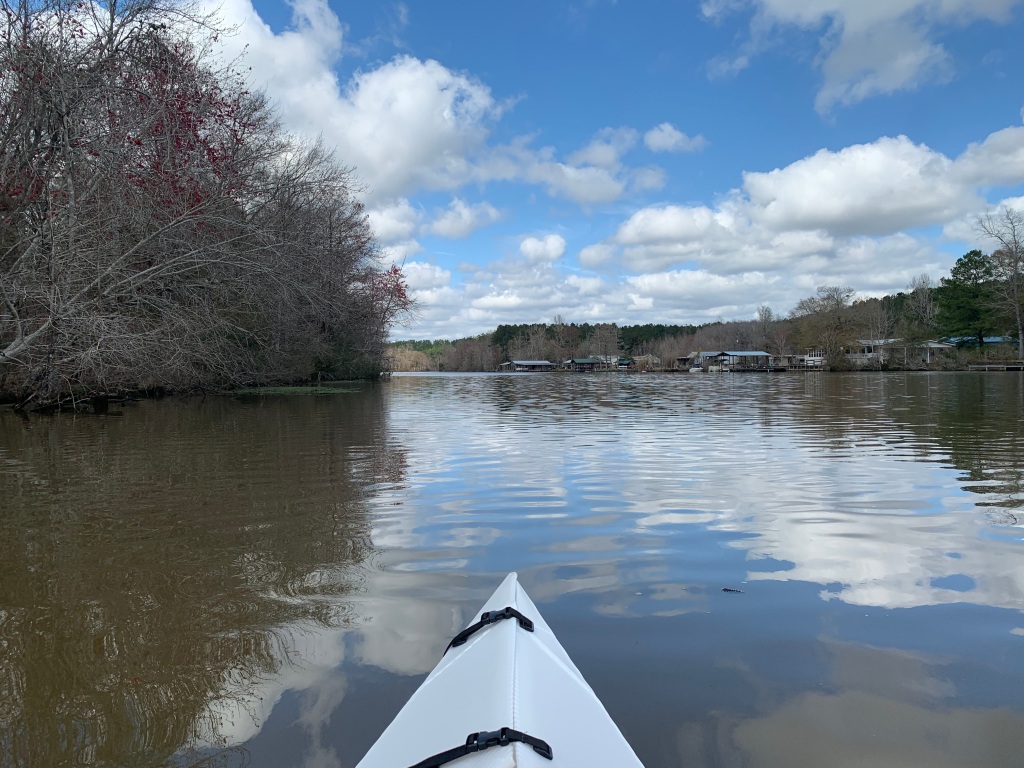
It felt refreshing to be on moving water again. I assumed this was the Conecuh River, which was impounded to create Point A Reservoir, just below. Turns out I was on a tributary of the Conecuh.
I calculated the current at about half a mile an hour, upstream first, just the way I like it. The limpkin called my attention with a strange, unfamiliar, piercing call that no one could miss, then segued to the clicking sound while walking. There were also many turtles out in the on again, off again sun.
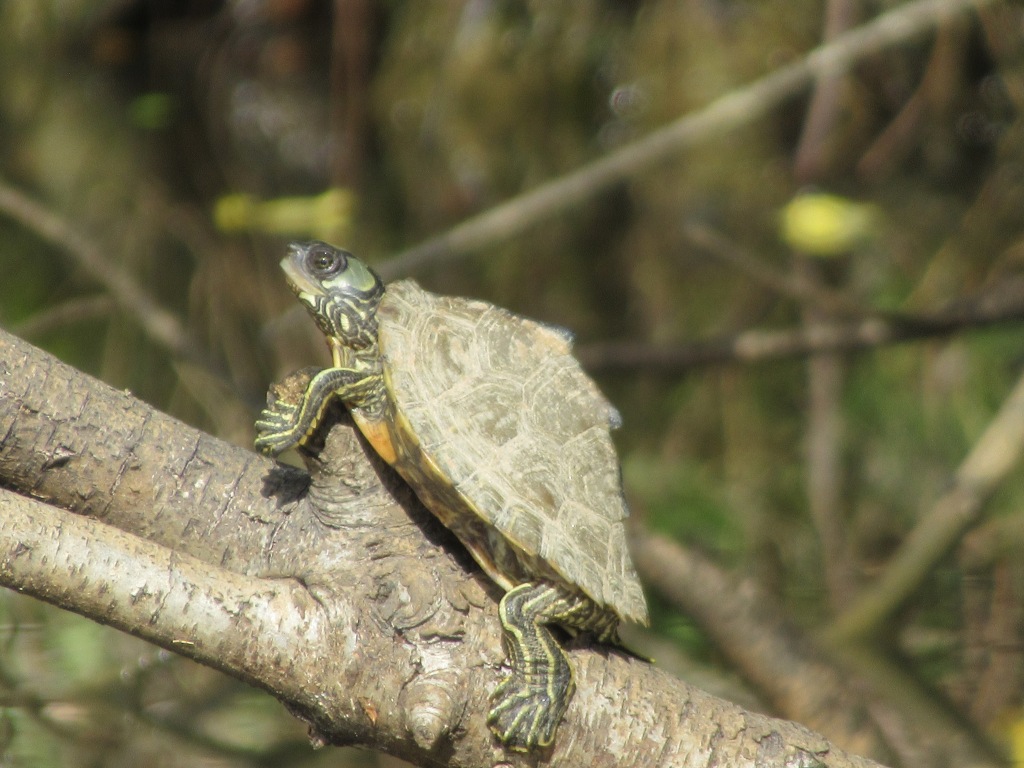
I’m still working on identifying this small map turtle. I saw many of these individuals with two distinctive bumps on their peaked shells, often clinging to steeply slanted branches.The friendly bass fisherman mentioned duck hunting up a little side creek, so I ventured up into this cypress swamp, where I quickly reached a dead end guarded by hungry mosquitoes.
I’ve been using my Garmin Etrex 30 handheld GPS on these paddles to measure distance. This out and back was a little over four miles total, with an average moving speed of 2.0 mph. I’m naturally a slow paddler who spends a lot of time drifting to look at and photograph my surroundings. For those of you keeping track, I now have about thirty-five miles on my new Oru Lake kayak.
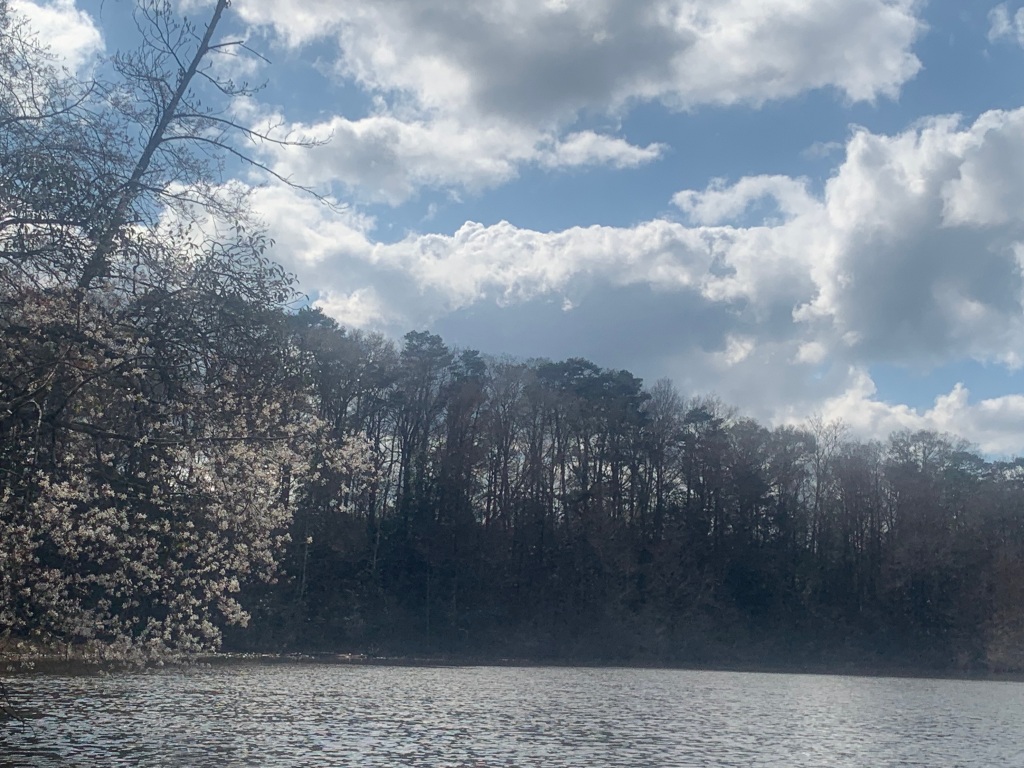
One of many flowering trees announcing the start of spring in Alabama. This one was a species of serviceberry or shadbush, perhaps downy serviceberry. This is the map I had to work with, an example of the drawbacks of embracing a spur-of-the-moment adventure. I launched at the upper #1, and the creek that I paddled up is not labeled.
A Civil War battlefield, The Florida National Scenic Trail, and kayaking Ocean Pond among giant cypress
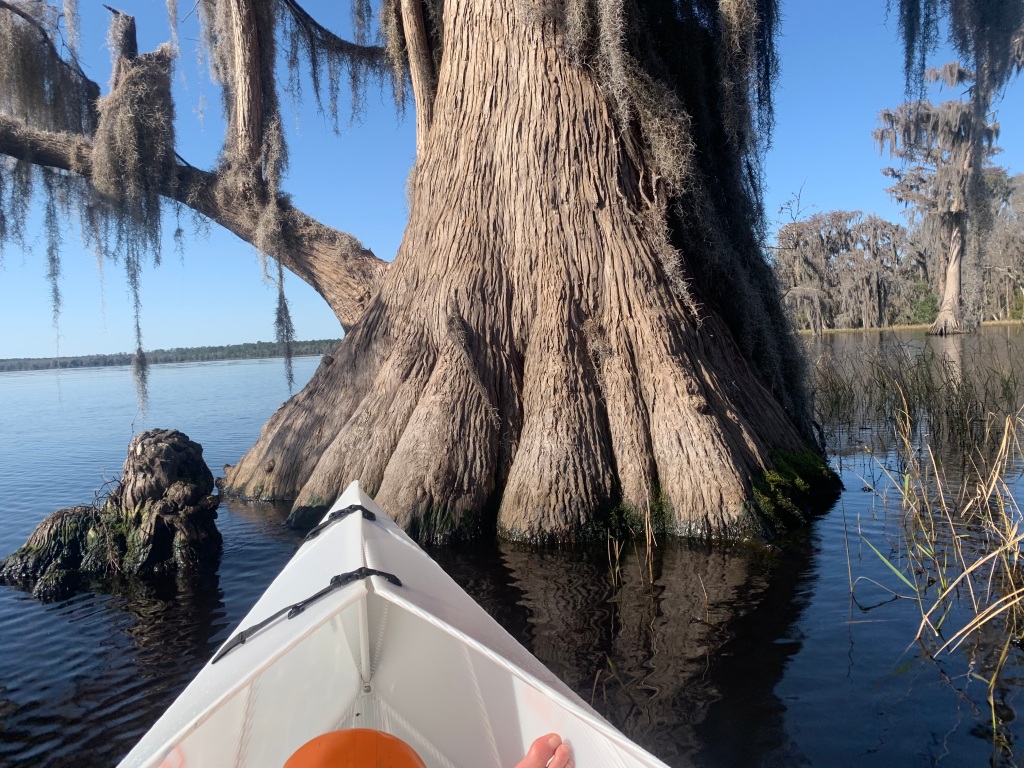
Paddling among giant cypress on Ocean Pond
Before sharing about Florida, I have to tell you that I have now astoundingly joined the ranks of DIY travel trailer fixer-uppers. (Although nothing is fixed yet). Much of this cold and rainy Alabama day has been devoted to trying to figure out why my refrigerator is not working. From the simple checks-breakers, fuses and plugs-I moved on to trying to secure a dealership repair appointment (impossible) or a visit from a mobile RV tech.
The closest tech turned out not to be close anymore as he now lives in Arkansas. But Ron was the best of trail angels, spending hours helping me over the phone. There I was with my multimeter, in the land of circuit boards, colored wires, and hidden fuses. Finally, through a Grand Design owners forum, I discovered a blown thermal fuse that I will soon try to repair. What a learning day!
Site #28 in the Ocean Pond Campground only had a water hookup. However, the generator and solar panel kept me up and running, all but the refrigerator. I sure was looking forward to having cold and frozen food in the campsites ahead, all of which have electricity.
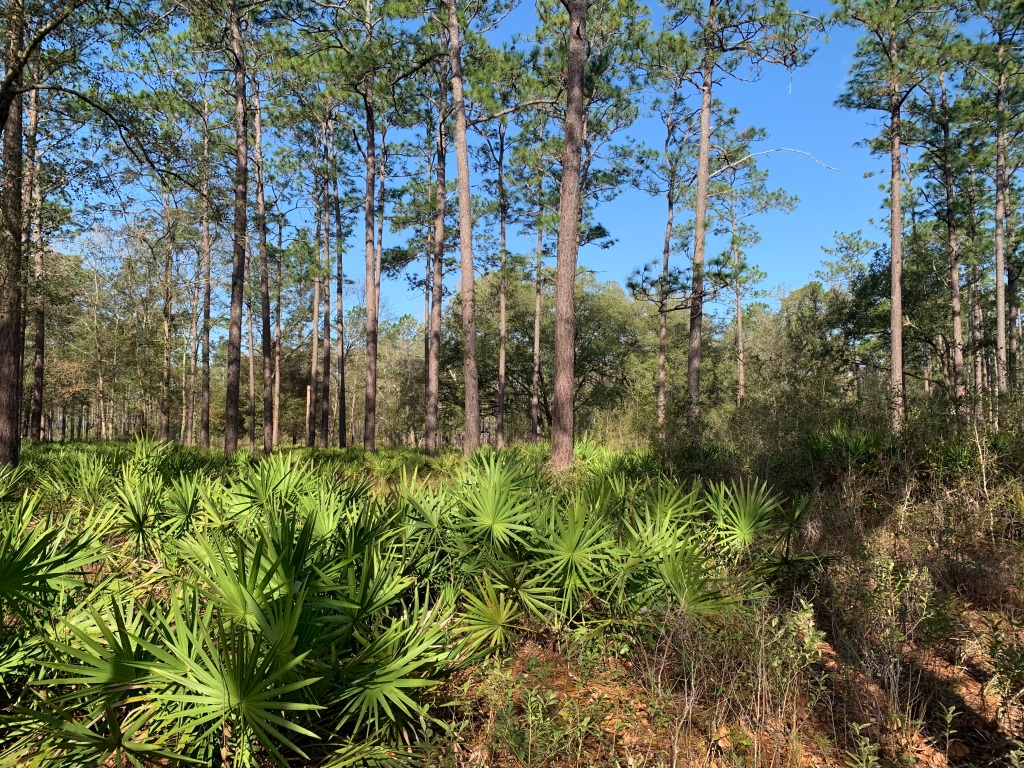
The largest Civil War battle to take place in Florida was fought nearby. The Olustee Battlefield Historic State Park was seven miles from camp. Interpretive panels along a one-mile trail told the story of the evenly matched battle through photographs, primary sources, and a clear narrative. The terrain of open pine woods and palmettos, interspersed with impassable swampy areas, helped me visualize the drama of that tragic day. Just over five thousand soldiers on each side-the Union hoping to cut off food supplies from Florida at the Suwanee River railroad bridge and the Confederates handing them a costly defeat.
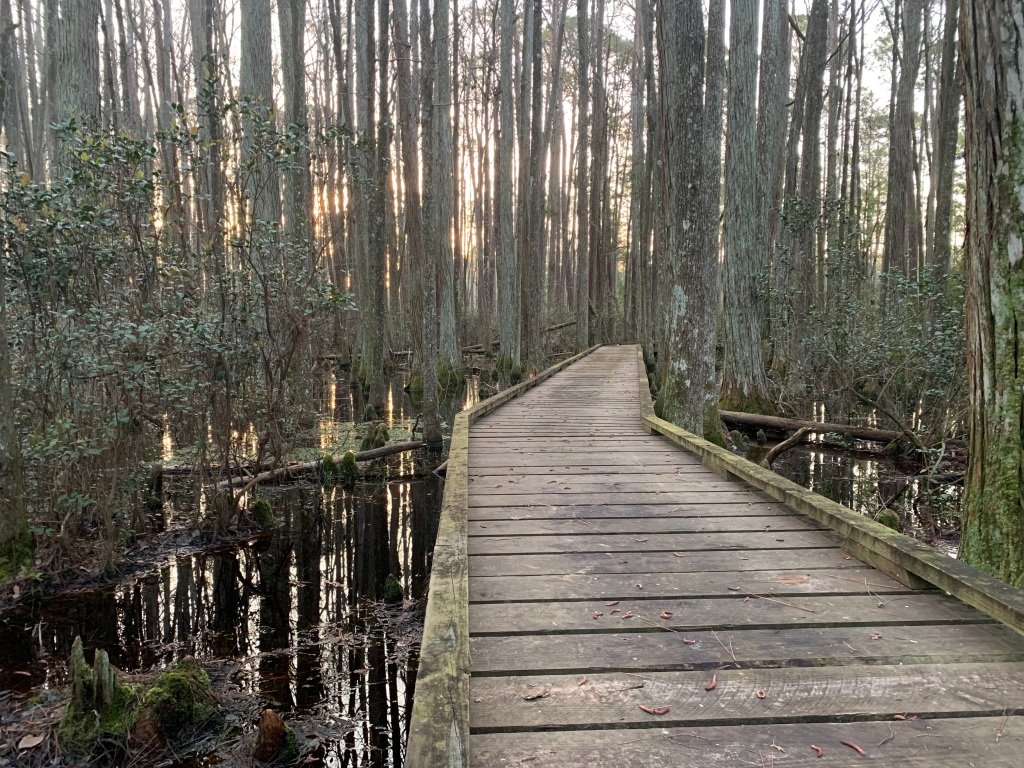
“Grape and canister swept by with hideous music, and shell after shell tore through our ranks and burst amid heaps of our wounded heroes,” remembered a soldier of the 115th New York.Huge crowds attend the re-enactment of the battle every Presidents Day weekend.Boardwalks are becoming a favorite haunt of mine. This one, through a cypress swamp on the Florida National Scenic Trail, enticed me to sit and write and study the verdant plant life.A native green anole (I think) at the edge of the cypress swamp. Anoles, like chameleons, can change color. In Florida, over two-thirds of the lizard species are invasives, including the brown anole, which arrived on cargo ships in the late 1800s. Females of both species look like this one.
Ocean Pond is the roundest body of water I have ever seen. One day, I kayaked around its almost 7-mile shoreline. The shallows near shore are picturesque, with turtles and water lilies among the cypress. I studied one patient great egret who was fishing there, swallowing his catch with bounces of his very long, thin neck. There were patches of pickerel weed, not yet in bloom, and cow lily (spatterdock) just beginning to show its bright yellow, spherical flowers. I love the touches of home to balance out all that is new and unusual.
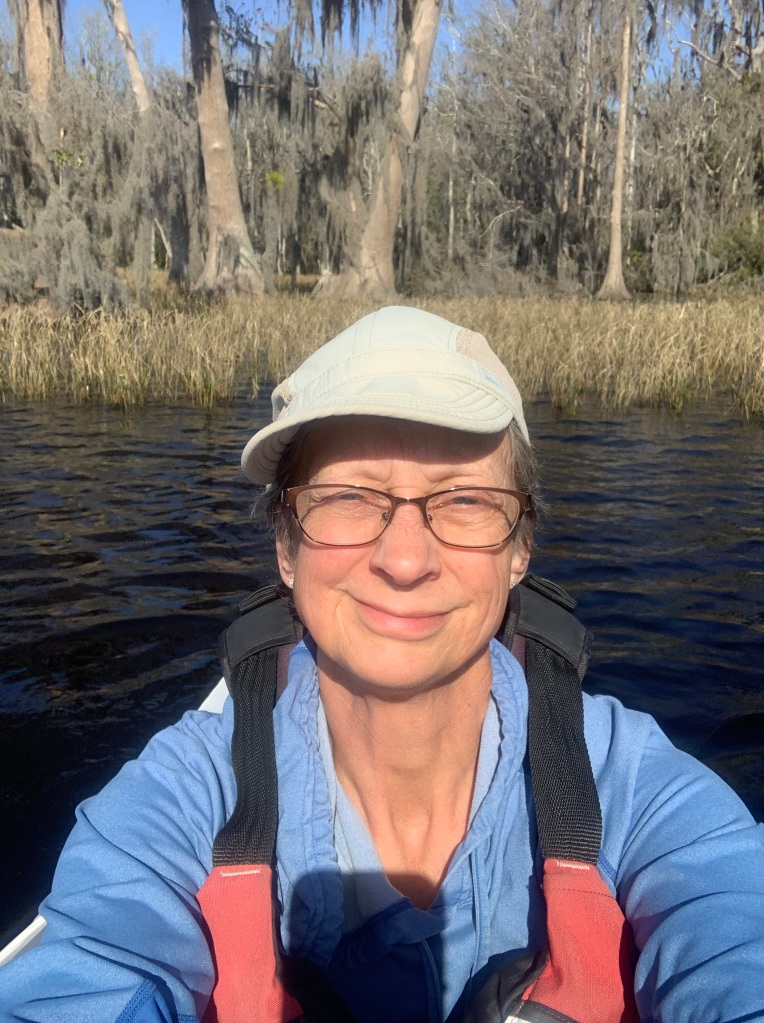
The border of grass behind me was present almost all the way around the lake and often prevented me from accessing the shallows, except where there were openings. Knowing that there were alligators around and it was a warm day made me cautious to plow through the grass and reeds.
I’ll finish with a shout out to the federal government for their America the Beautiful Lifetime Senior Pass, available to those 62 and older. For a one-time cost of $80, mine has already paid for itself two times over since I purchased it on January 5th. How grateful I am to be experiencing all these natural wonders at such an affordable price!
Thrilling encounters with my first alligators while paddling my Oru folding kayak
Some stories need to be told right when they happen! Between North Carolina and here, I spent six nights off-grid in the Brick House campground in South Carolina’s Sumter National Forest. I’ll get back to that sojourn, which featured frigid temperatures, an ailing generator, and hiking the Palmetto Trail, later.
This 630-square-mile wildlife refuge includes the majority of the Okefenokee Swamp. The refuge’s main entrance is located off Route 121 in Folkston, Georgia.
Struggling to back my trailer in just where I wanted it was the perfect way to meet my backyard neighbors at the Blythe Island Regional Park campground in Brunswick, Georgia. Roy came over to quietly advise me and his wife Sue soon followed with information about some canoeing they’d been doing. The water trails at the wildlife refuge were a true discovery, and I knew I had to go explore them. Roy and Sue had seen and heard flocks of sandhill cranes and showed me photos of the Suwannee Canal, which begins at the visitor’s center.
Spanish moss drapes water-loving cypress along the shores of the 1891 canal
At the visitor’s center, I scooped up some fabulous free stickers for my growing collection and got an orientation to the water trails. As I had to be off the water by 4:30 p.m., I would do the length of the canal and back, around four miles, but would not get to explore any more of the water trail system.
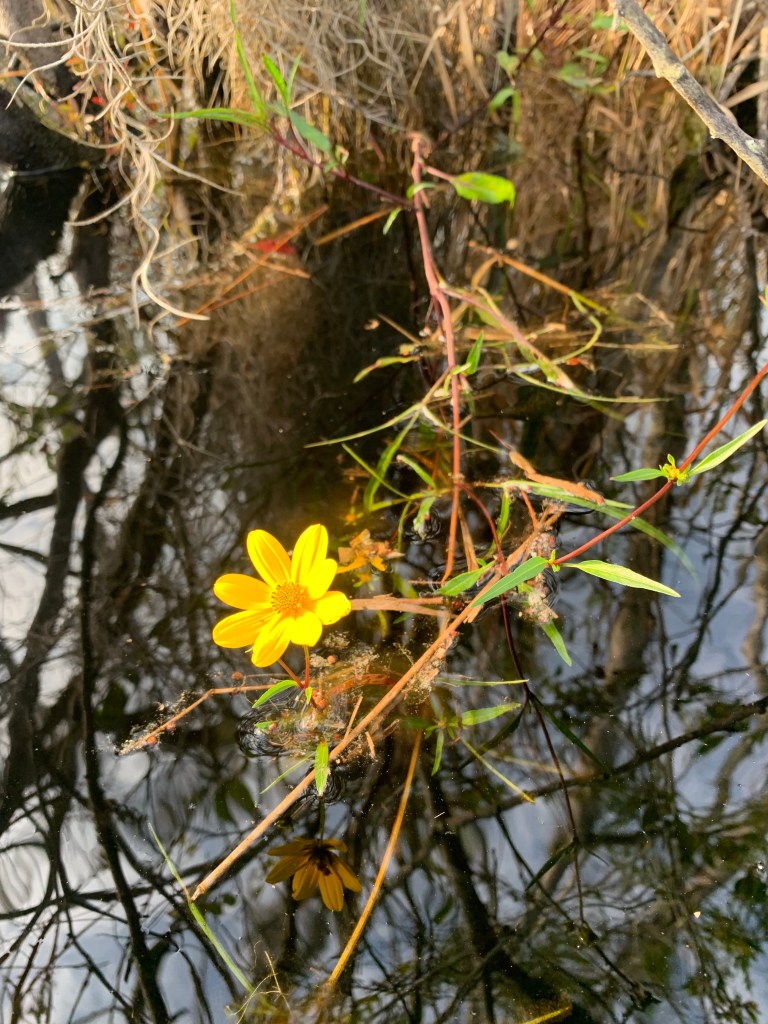
How long has it been since I’ve seen a flower blooming?
The startling news was that lots of alligators had been seen basking in the sun on this 70-degree day! You think I’ll get to see one? I asked in surprise, as much excited as apprehensive. Oh, there’s no doubt, replied the ranger. He then assured me that alligators are not aggressive, and you can paddle to within fifteen feet to photograph them. Most of the time, in January, alligators are in brumation, a type of torpor where heart rate and metabolism slow down. On warmer days, though, when you start seeing turtles out, snakes and alligators will also be active.
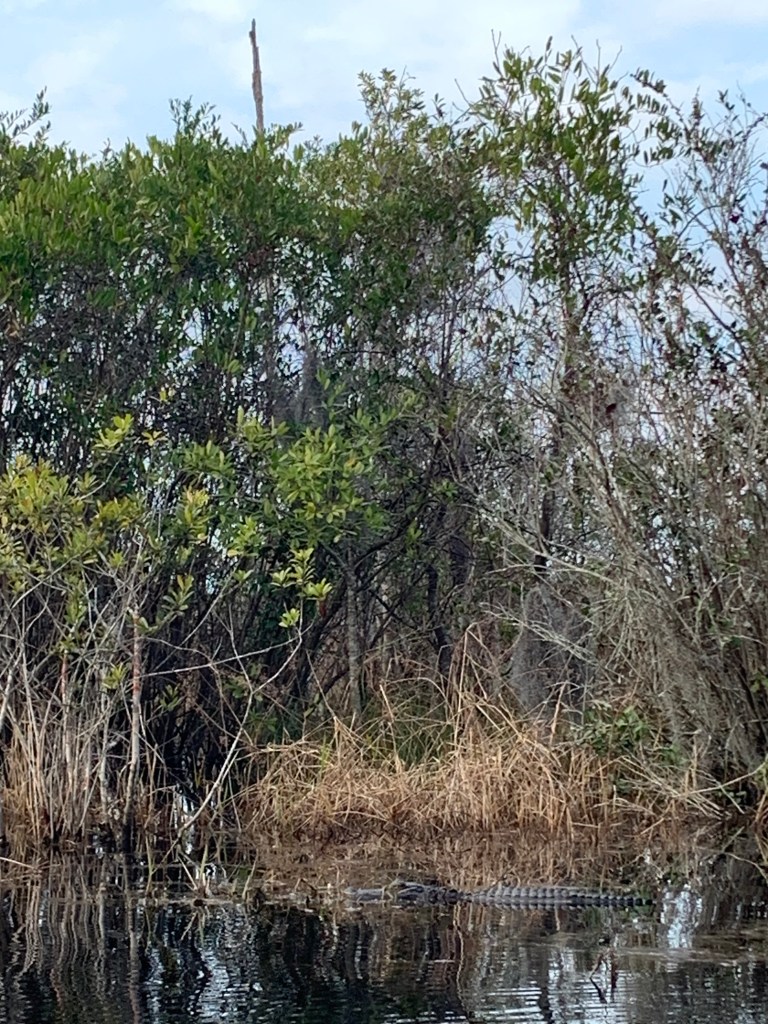
Every sense was on alert as I scanned the banks. In addition to reptiles, I was on the lookout for river otter or the elusive American bittern, both of which had been spotted today. The alligators would be sunning on the banks. I probed the tall dry grass and peered into the water under shrubby brush. Finally, a shape emerged, like jagged teeth…an alligator tail. It was a big one, and looking closely, I could see his body and head, facing away from me. The wind pushed me away, until trees hid his form. I paddled back again and again, not really believing that here I was in my little folding kayak communing with a gator!
Some of the big fellows were hard to spot. This one is tail first straight ahead of the kayak.
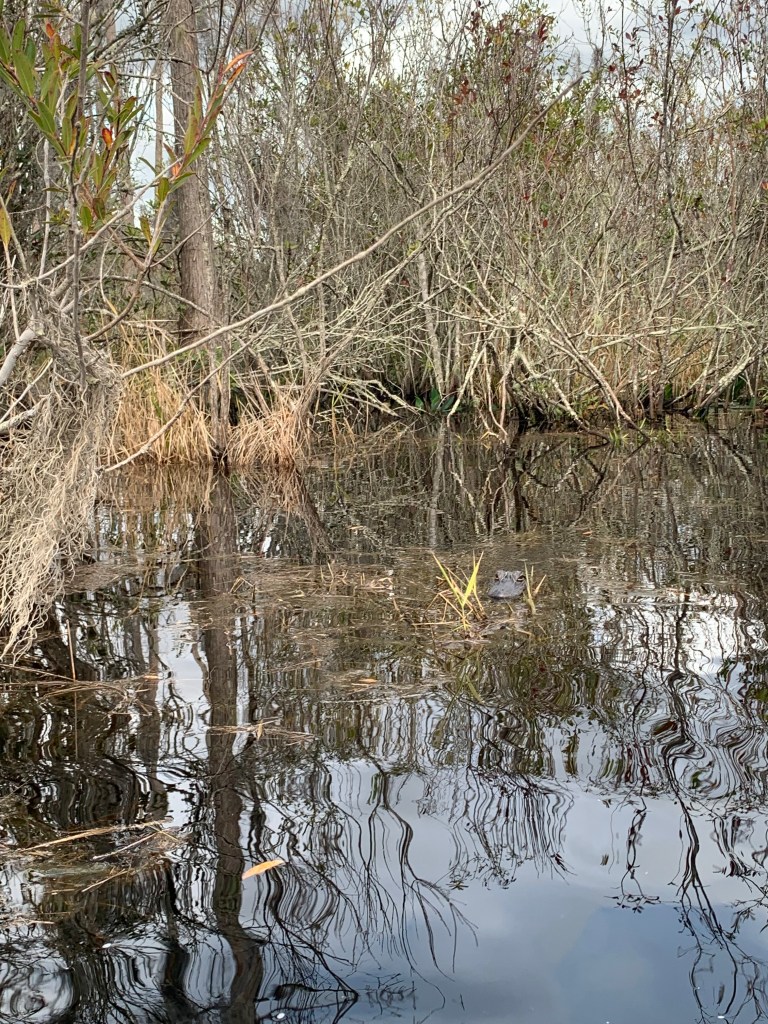
In two hours, I spotted eleven, four going out and seven coming back, so perhaps there were repeats. As I learned what to look for and where, they were easier to find. Two acknowledged my presence: a large one that slowly sank until only the top of his head and eyes were visible and a small one that twisted into the water with a big splash when I got too close. That was creepy, to have him somewhere underwater, not too far away!
Keeping an eye on each other!
My only regret was that I couldn’t stay longer and explore more. The refuge is home to flocks of white ibis and wood storks, as well at the sandhill cranes that Sue and Roy witnessed. Fifteen species of turtles make their home here. Perhaps someday I will return, to paddle farther and hike some of the trails as well.









 Laurie Apgar Chandler