Roaming Savannah’s most iconic and photogenic cemetery
Memories of those long gone live on in emotive statuary
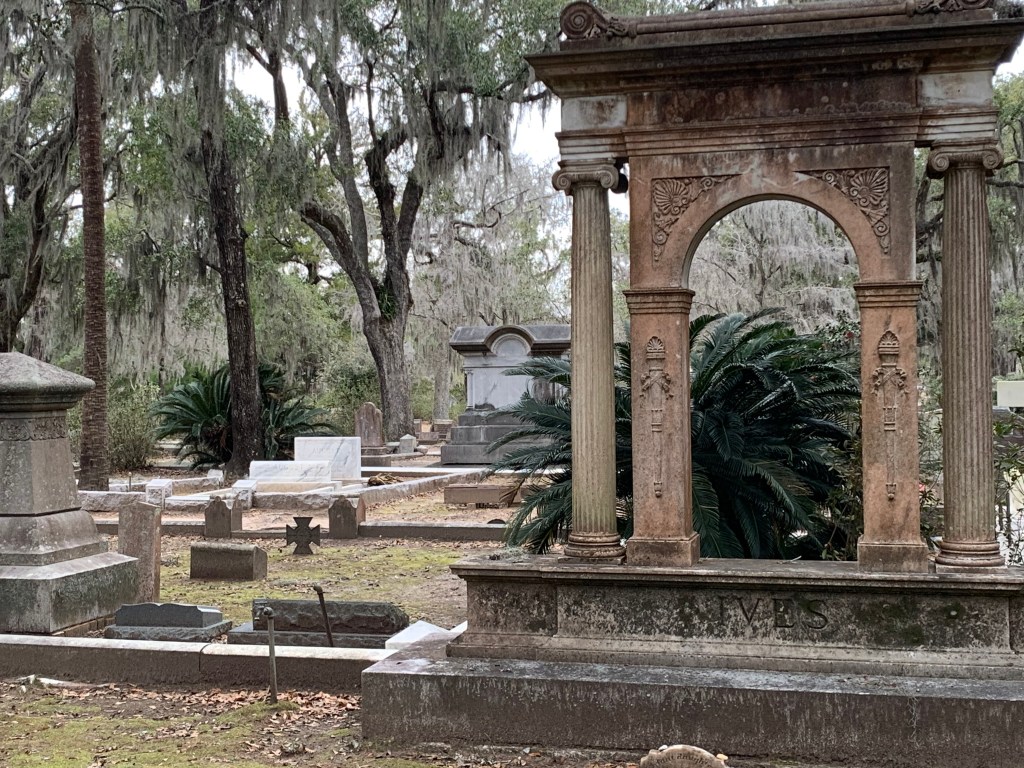
For decades, the book and movie, Midnight in the Garden of Good and Evil, have drawn visitors to Savannah’s Bonaventure Cemetery. Arriving there yesterday with only 45 minutes until the gates would close, we found it mostly empty. Just driving the sandy roads from section to section gave us a deep sense of its spirit and mystique. We parked near the river, strapped Emilia into her carrier, and set out to absorb the aura of this legendary place. Its most famous statue, by Sylvia Shaw Judson, is called the Bird Girl. After gracing the cover of the bestseller, it was moved to the Telfair Academy Museum in the city. However, we would have no trouble discovering many of our own favorites.
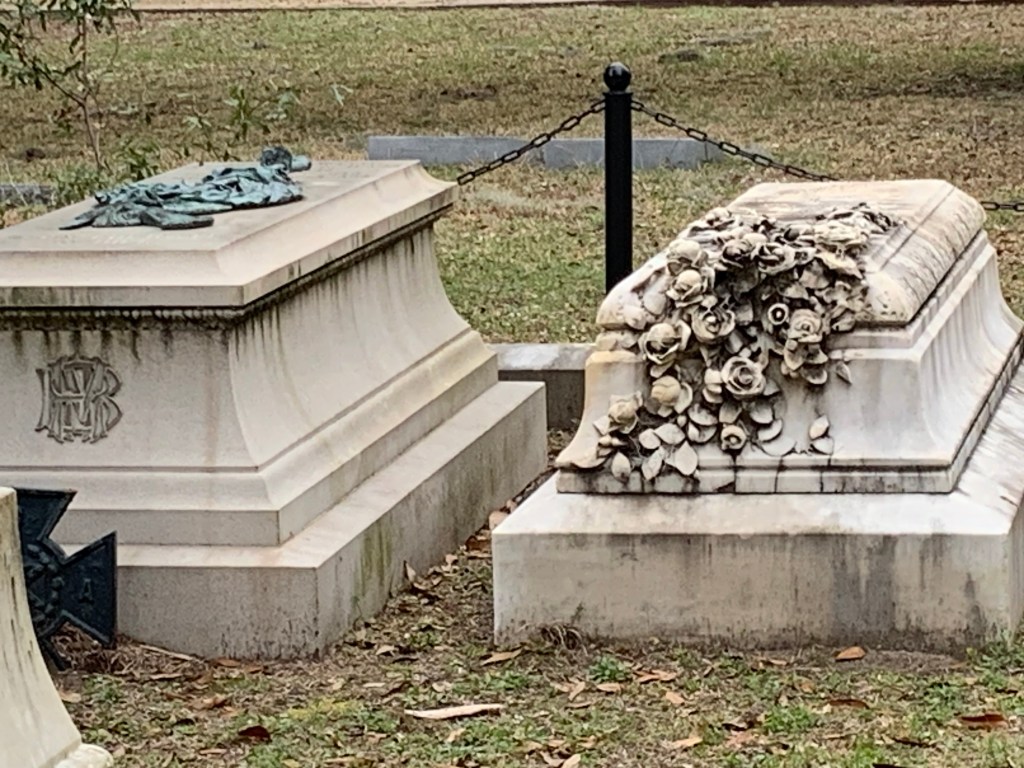
The cemetery’s character draws from its compact layout and juxtaposition of manmade and natural elements. The weather and time of day added to the ambiance.My daughter Megan discovered this sweet spot of flowers and Spanish moss.Many examples of intricate raised carvings indicate the wealth of those buried here
Just by chance, we happened upon one of the more famous and poignant gravesites. A worn stone plaque told the story of Little Gracie Watson. The “beautiful and charming” six-year-old died of pneumonia two days before Easter 1890. She was very well loved, a favorite of guests at Savannah’s Pulaski House Hotel, where her father was the manager. Today, visitors leave gifts outside the fence that surrounds her plot. Her moving, but solemn, likeness is an early work of sculptor John Walz, who would go on to create over 100 sculptures in Bonaventure.
Some say that Little Gracie’s joyful laugh can still be heard in the bank that currently stands on the site of the former Pulaski House Hotel on Johnson Square.
A wildlife bonanza and kayaking serendipity right at camp
This campground, part of a park run by Glynn County, was my home for three nights, arriving January 23rd and departing January 26th. After the long excursion to Okefenokee, I decided to stay and enjoy the park on my last day. Chores and writing got accomplished, but I also just relaxed. While my laundry was drying in the laundromat, I walked over to the park’s public marina on the tidal South Brunswick River. The birds, there, oh my, I just couldn’t believe it!
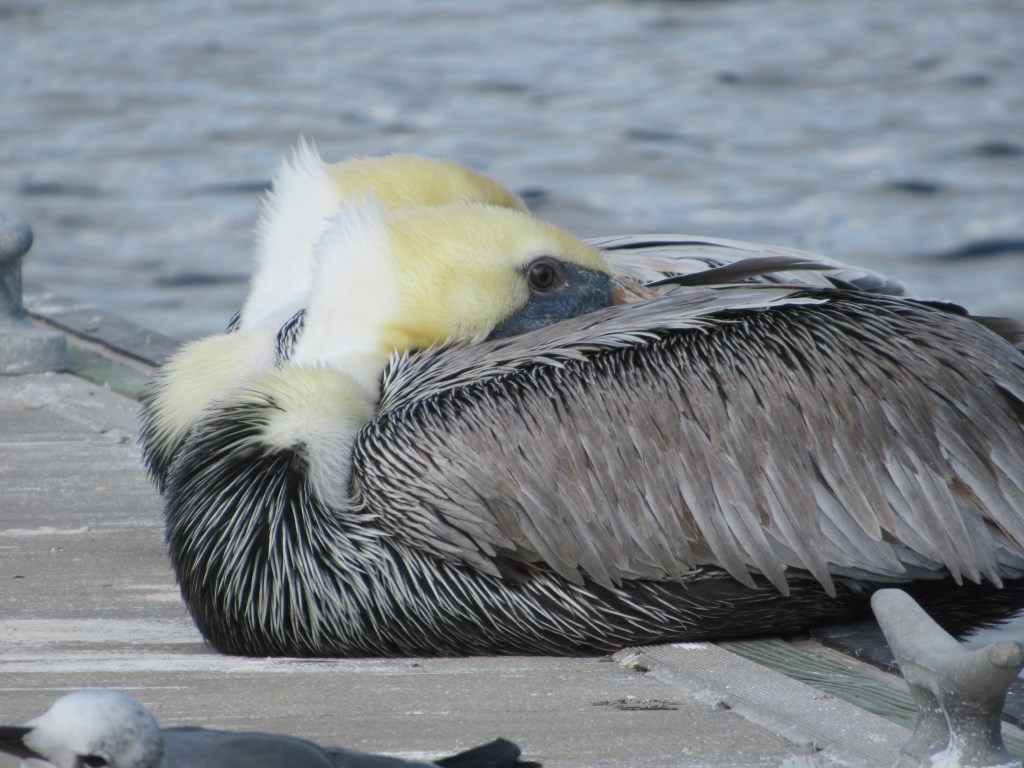
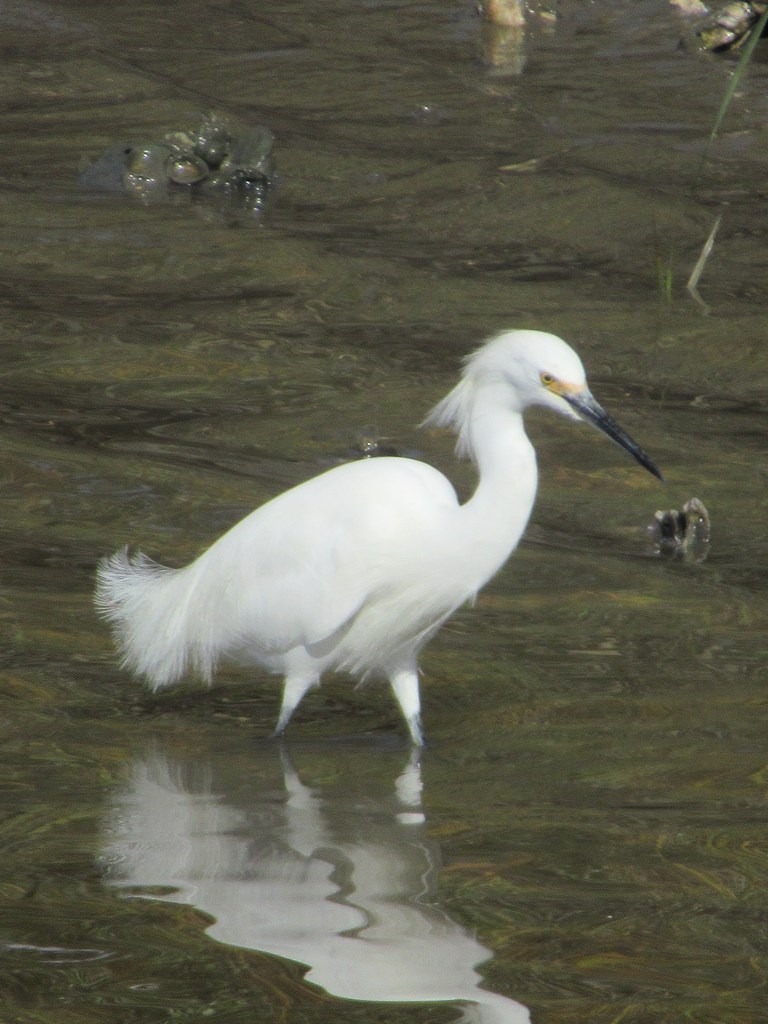
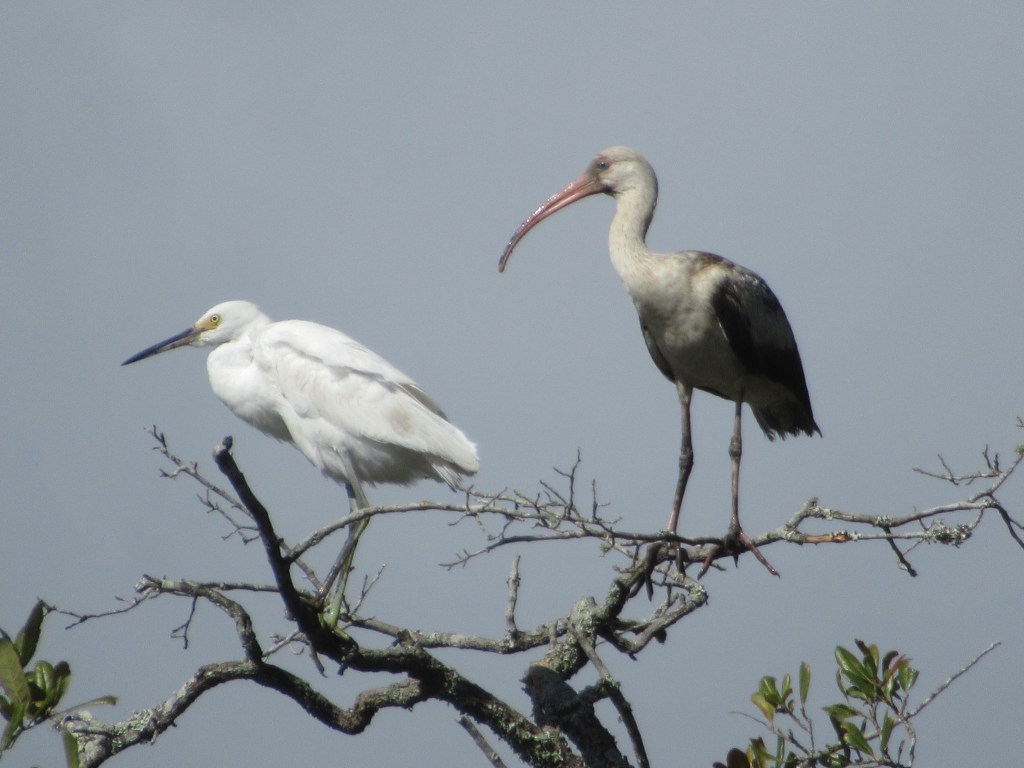
On the dock, a pair of brown pelicans posed willingly, their fuzzy yellow heads so soft in contrast to their much coarser gray body feathers, wet from the brackish water.Another intriguing poseA male hooded merganser popped up next. I watched him dive and preen, gazing down from behind a long fish cleaning table that mostly hid me from sight. The snowy egret can be identified by its bright yellow feet, which I clearly saw as he stalked along.Then there were these buddies. The immature little blue heron on the left, with its distinctive green legs, flew in first. Then came the bird on the right, which I believe is an immature white ibis.Two youngsters enjoying the hot sun and refreshing breeze, hanging out together.
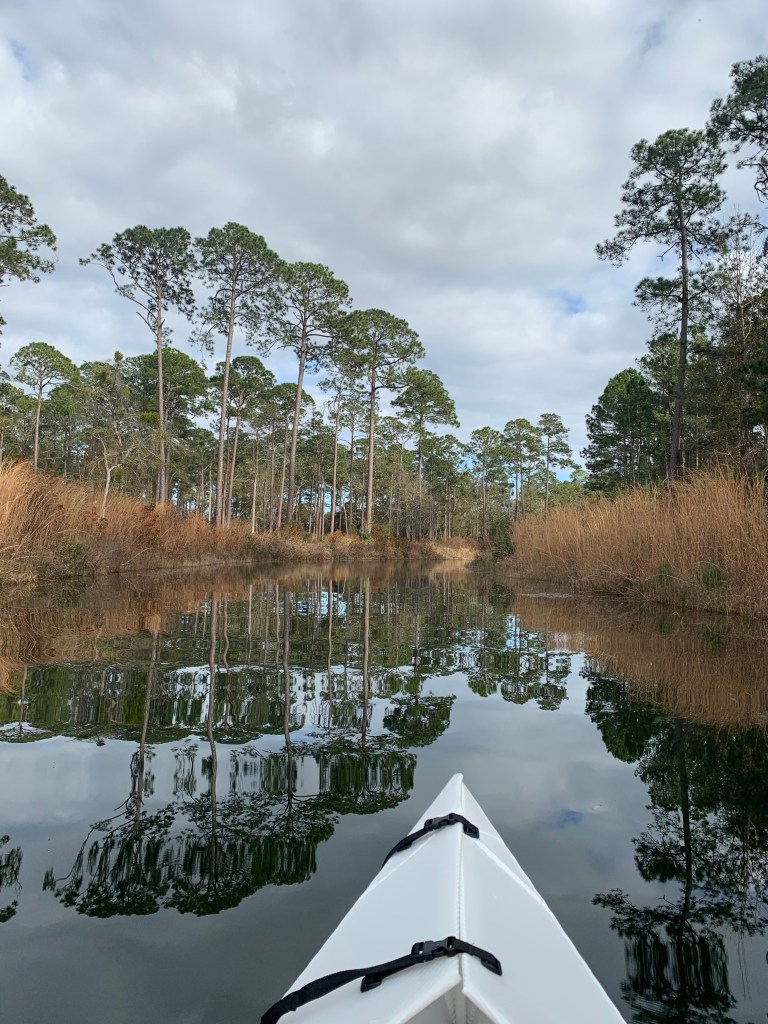
Later that afternoon, I ambled out of my camp chair, assembled the kayak, and plopped it into the water that I could see from my front window. There are two tiny lakes there, but it turns out there is a canal (or stream?) that flows out the far side. Paddling past more egrets and a shy turtle, I followed the current into the narrow passage, past longleaf pine above and rhododendron below. Once, I turned back briefly just to make sure that going against the current would be doable.
If I hadn’t stayed to relax at camp, I would have missed this gem.Today’s mystery water plant, observed in several large matted clumps
Exploring that canal and a couple of dead end turns off of it, I ended up paddling almost three miles. Meanwhile, there was a small problem in paradise. Fires ants! Carrying the kayak down, I had been bitten four times. I recognized that stinging pain right away, but it took a minute to find them under my Teva strap. A day later, my left foot would be swollen and very itchy, with blisters where the bites were and an ugly reddish color to the front half of my foot.
I will spare you a photo of that!
Last character of the day’s wildlife bonanza was this armadillo, spotted as I drove back home with a takeout shrimp po boy from Fish Tails Pub & Grill, right down the road.
Thrilling encounters with my first alligators while paddling my Oru folding kayak
Some stories need to be told right when they happen! Between North Carolina and here, I spent six nights off-grid in the Brick House campground in South Carolina’s Sumter National Forest. I’ll get back to that sojourn, which featured frigid temperatures, an ailing generator, and hiking the Palmetto Trail, later.
This 630-square-mile wildlife refuge includes the majority of the Okefenokee Swamp. The refuge’s main entrance is located off Route 121 in Folkston, Georgia.
Struggling to back my trailer in just where I wanted it was the perfect way to meet my backyard neighbors at the Blythe Island Regional Park campground in Brunswick, Georgia. Roy came over to quietly advise me and his wife Sue soon followed with information about some canoeing they’d been doing. The water trails at the wildlife refuge were a true discovery, and I knew I had to go explore them. Roy and Sue had seen and heard flocks of sandhill cranes and showed me photos of the Suwannee Canal, which begins at the visitor’s center.
Spanish moss drapes water-loving cypress along the shores of the 1891 canal
At the visitor’s center, I scooped up some fabulous free stickers for my growing collection and got an orientation to the water trails. As I had to be off the water by 4:30 p.m., I would do the length of the canal and back, around four miles, but would not get to explore any more of the water trail system.
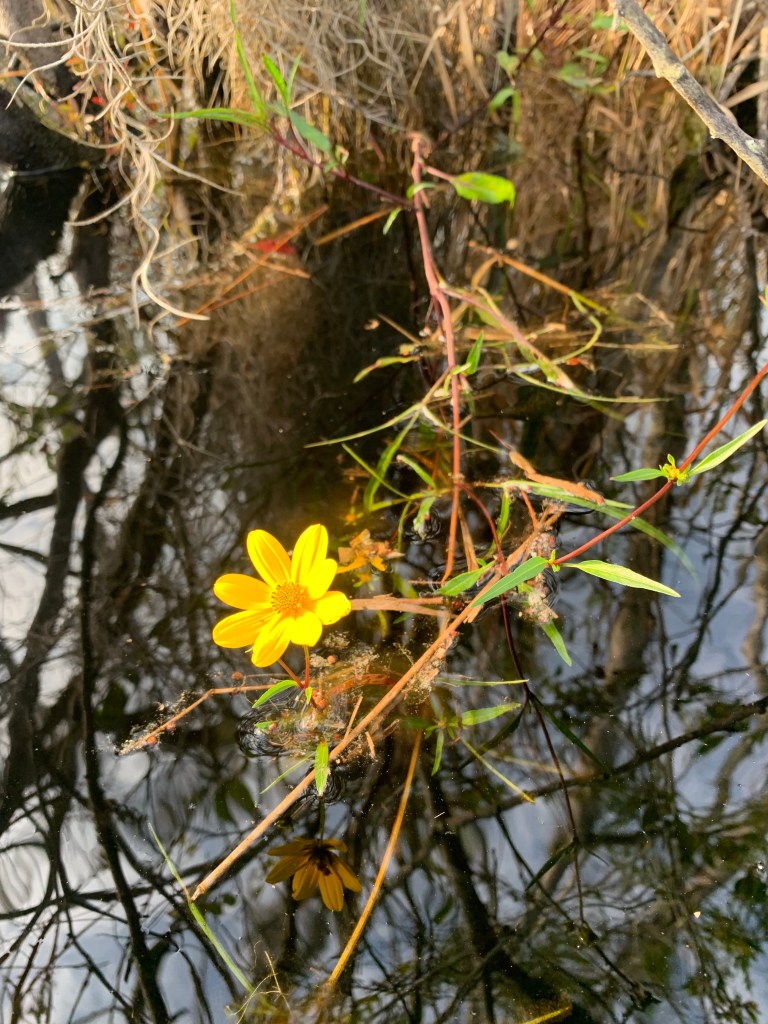
How long has it been since I’ve seen a flower blooming?
The startling news was that lots of alligators had been seen basking in the sun on this 70-degree day! You think I’ll get to see one? I asked in surprise, as much excited as apprehensive. Oh, there’s no doubt, replied the ranger. He then assured me that alligators are not aggressive, and you can paddle to within fifteen feet to photograph them. Most of the time, in January, alligators are in brumation, a type of torpor where heart rate and metabolism slow down. On warmer days, though, when you start seeing turtles out, snakes and alligators will also be active.
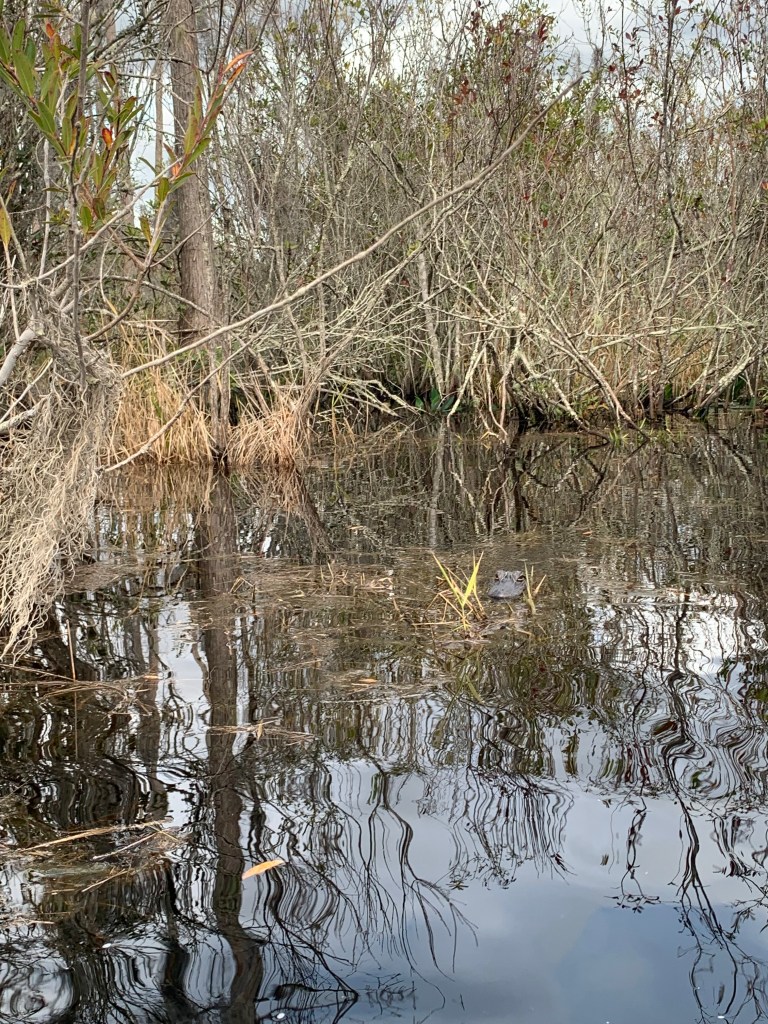
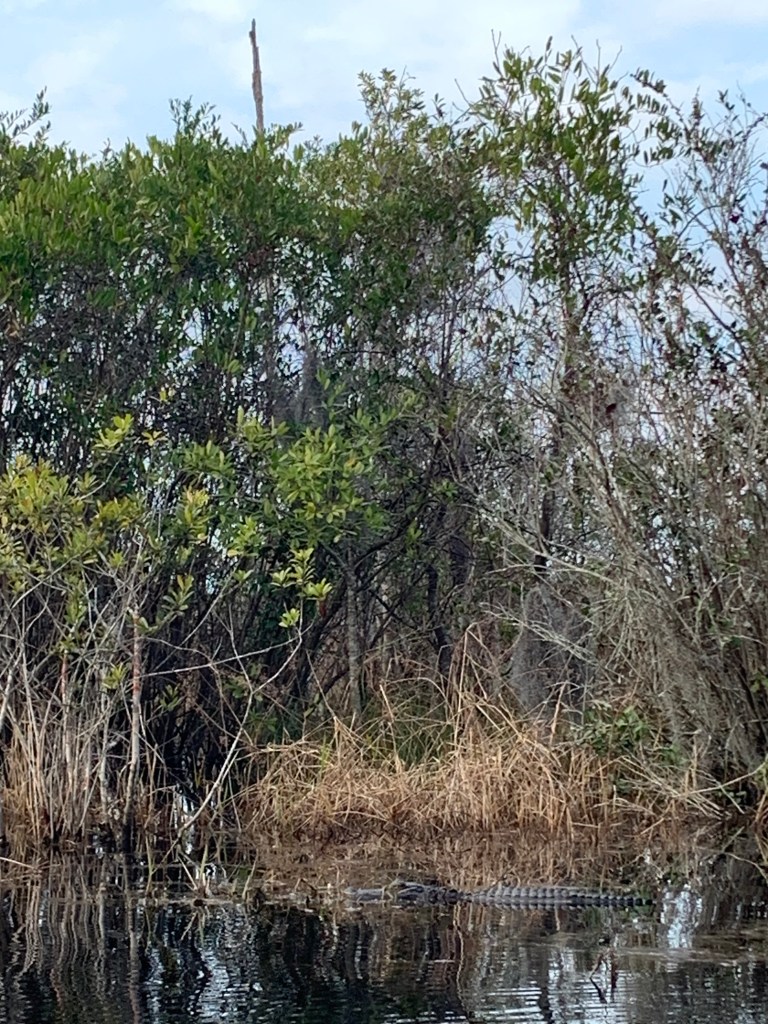
Every sense was on alert as I scanned the banks. In addition to reptiles, I was on the lookout for river otter or the elusive American bittern, both of which had been spotted today. The alligators would be sunning on the banks. I probed the tall dry grass and peered into the water under shrubby brush. Finally, a shape emerged, like jagged teeth…an alligator tail. It was a big one, and looking closely, I could see his body and head, facing away from me. The wind pushed me away, until trees hid his form. I paddled back again and again, not really believing that here I was in my little folding kayak communing with a gator!
Some of the big fellows were hard to spot. This one is tail first straight ahead of the kayak.
In two hours, I spotted eleven, four going out and seven coming back, so perhaps there were repeats. As I learned what to look for and where, they were easier to find. Two acknowledged my presence: a large one that slowly sank until only the top of his head and eyes were visible and a small one that twisted into the water with a big splash when I got too close. That was creepy, to have him somewhere underwater, not too far away!
Keeping an eye on each other!
My only regret was that I couldn’t stay longer and explore more. The refuge is home to flocks of white ibis and wood storks, as well at the sandhill cranes that Sue and Roy witnessed. Fifteen species of turtles make their home here. Perhaps someday I will return, to paddle farther and hike some of the trails as well.










 Laurie Apgar Chandler