A chance to give back: Macedonia Lake, Sumter NF, SC

A community service opportunity for me and my folding Oru kayak

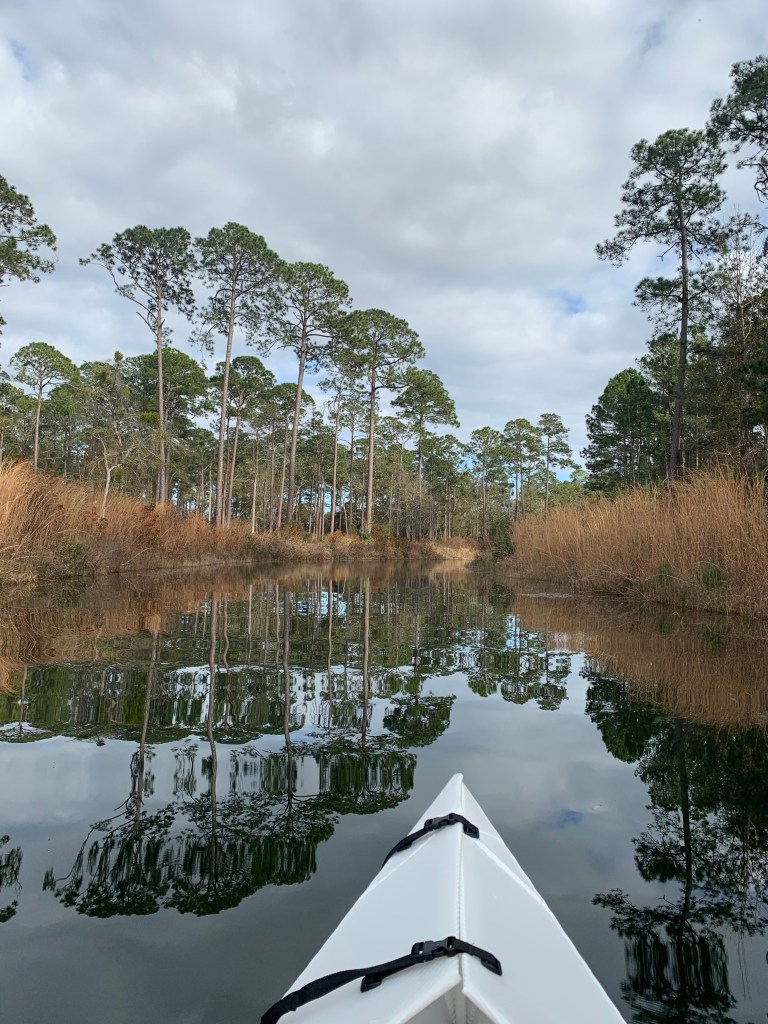
My folding kayak and I had tiny Macedonia Lake all to ourselves

The people of South Carolina were warm and friendly, helpful and welcoming, but they were also few and far between. The trail angel prize goes to an empathetic guy at a local YMCA, who must have sensed my desperation over the phone. Although there was no day pass option there, he generously offered to let me shower if I showed up before his shift ended. The copious hot water was the best! The congregation at the Fairview Baptist Church, several propane tank fillers, a waitress, and a highway worker ensuring I wasn’t lost rounded out the list of human contact for an entire week. (Unfortunately, the highway worker did not appear on the occasion that I was actually lost).

Consequently, the young man who cruised into the Brick House Campground on Sunday afternoon was a welcome visitor. His question about my solar setup soon evolved into a lengthy chat covering everything from local seafood specialties to the benefits of solitude. When I asked if he did any fishing (still thinking about those giant catfish), he recommended a visit to Macedonia Lake. This small waterbody, located about seventeen miles north of the campground along the Palmetto Trail, is also accessible by road.

Ready to explore tiny Macedonia Lake

As I was planning this winter’s journey, I thought a lot about how to interact with communities along the way. One thought was to participate in some community service events. I almost connected with one at the Fairview Baptist Church. They had an ambitious Brunswick stew fundraiser coming up, but I would be already gone when the day came to peel all those potatoes.

At Macedonia Lake, I discovered a project just as beneficial.

Evidence of an active beaver population

So, let’s talk trash…garbage, refuse, litter. With special emphasis on bottles, cans, fishing line, foam cups, bait containers, bobbers, and empty chip bags. Although cleanup crews are making a valiant effort along the highways of the South, the amount of trash in the water is appalling. It makes me sad, and also reinforces my gratitude for the cleanliness of our northern waters. At home, I might snag one wayward beer can or water bottle in hours of canoeing.

In the south, the sheer volume of trash I had seen so far was overwhelming. Macedonia Lake was no exception. After cruising the shoreline (a quarter hour of slow paddling) and sitting for a while to listen for birds, it didn’t seem like much of an accomplishment. Until I thought of trying to pick up all the trash that I could reach from the kayak, counting items as I went. Luckily, I found a trash bag and plastic gloves in my pickup.

The black bag was already full and had been left at the boat launch.

I did not by any means get all the trash. Despite some tight maneuvering and teasing bottles and cans towards me with the paddle, I left a fair amount behind. Plus, the far shore had its own boat ramp peppered with trash that I did not have room for in the kayak. My count stood at 45 items when I’d made the shoreline circuit once again. Some bottles had obviously been there for years. Long enough for countless people to have done what I was doing. To round out the day, I gathered more than 55 more items from the boat ramp area in just a few minutes. What were people thinking?

A week later, at the Georgia Sea Turtle Center on Jekyll Island, a display would remind me of the time it would take for some of this trash to degrade: monofilament fishing line (600 years), the wine bottle I found floating in the lake (undetermined), foam cups (50 years), plastic bottles (450 years), and aluminum cans (80 to 200 years).

Usually, I try to end my posts with a pretty picture or a positive thought. Today, I just want to encourage each and every person who sees trash like this to pick up some of it. Simply that. Leave our natural world cleaner than you found it.
Frigid nights: Brick House Campground, Sumter NF, SC

The challenges and discoveries of January off-grid camping

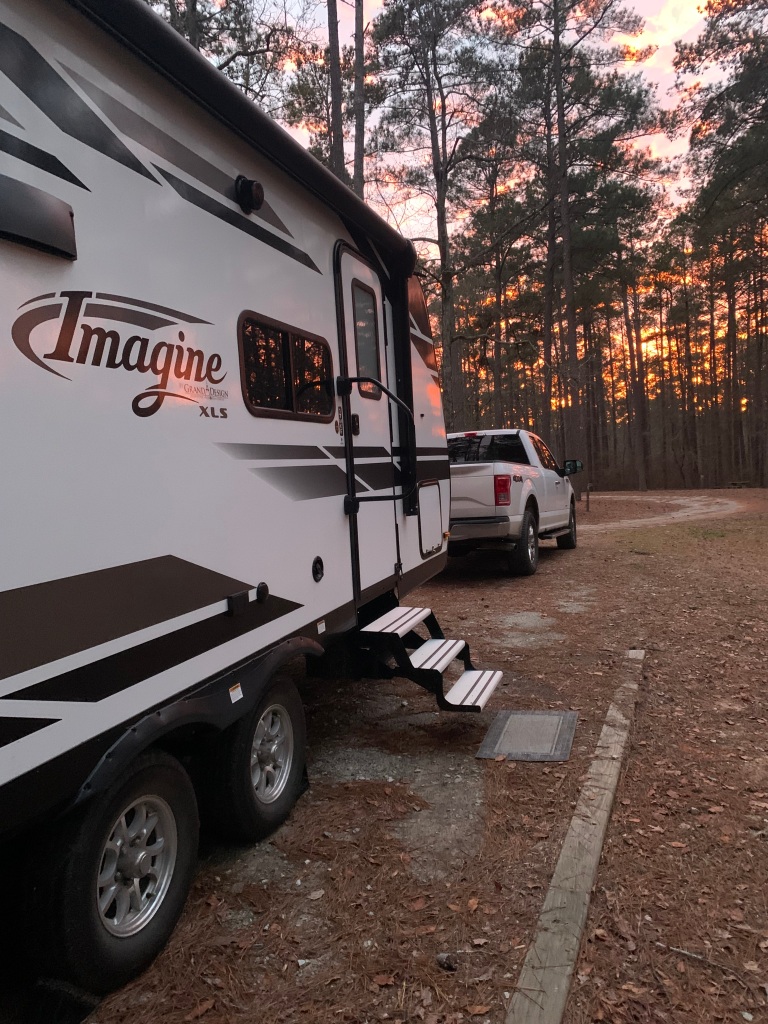
Sunset bathes my campsite at the spacious Brick House Campground

Hmmm, it’s hard to say which was scarier. The nights where it went down to lows of 13 and 16, and the generator was running rough. Or the last night, where the temperature hovered around freezing, but the generator was gone, gone, gone. This campground, which did have vault toilets, gave me a true test of off-grid winter camping without electricity or water. My few neighbors, hardy souls, were all in tents, cars, or amazingly, a hammock! With the generator needing some warranty repairs, I ended up cutting my stay short, but managed to pack a lot into six days.

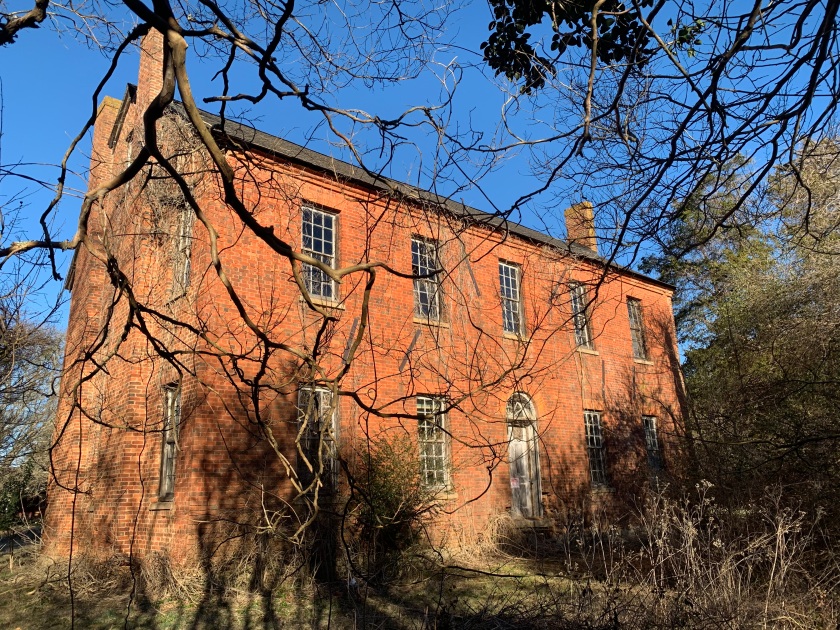
The mysterious, uninhabited brick house from which the campground takes its name

I’d been camping there for a couple of days before I put the pieces together. The grand, obviously historic, brick house across the road must have inspired the campground name. After that, it took some research to learn more. Locals were undecided if it dated to the Revolutionary or Civil War era. From the road, almost shrouded from view by tangled vegetation, it had an aura that spoke of untold stories. I’ve uncovered a few of them already. The house dates to the early 1800s and was built by Dr. Francis Fielding Calmes, using bricks made on a nearby creek. To me, its double chimneys and simple decorative brickwork give it timeless class. It seems a true loss that no one lives there now.

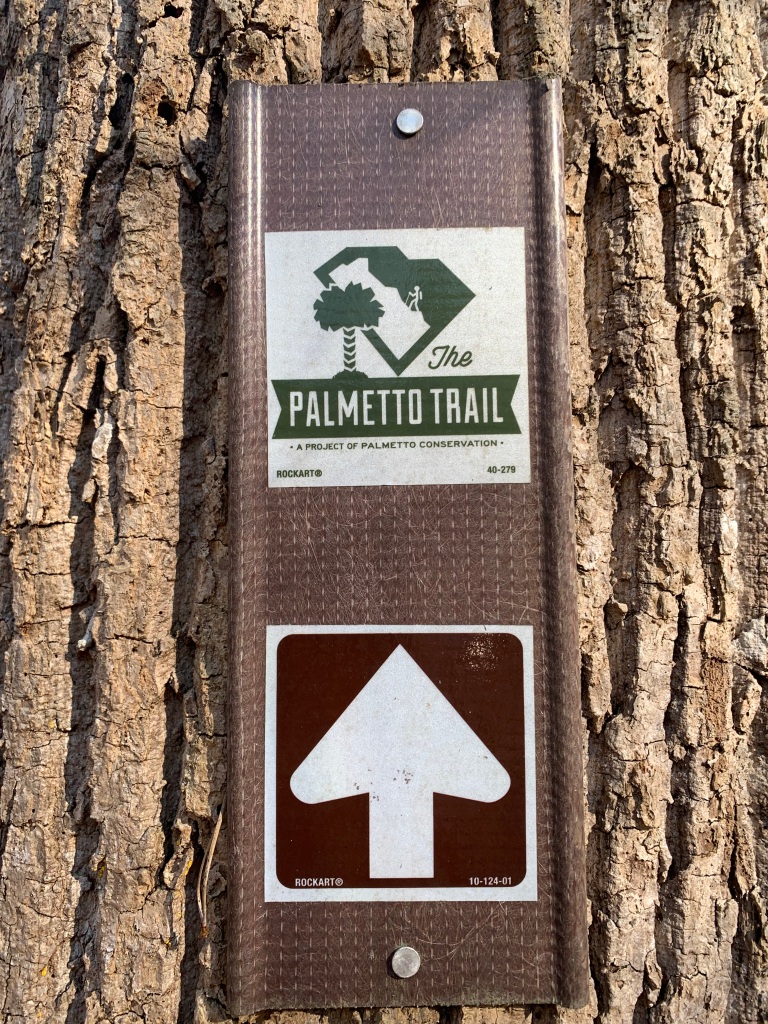
The Palmetto Trail runs right along the edge of the campground

Still a work in progress, the Palmetto Trail for hikers and bikers will eventually connect the Blue Ridge Mountains to the Intracoastal Waterway. According to USFS literature, 380 of its eventual 500 miles are finished. I explored it to the north, pleasant hiking on old woods roads and soft forest paths. Highlights were the small, white sandy streams and areas of steep gullies and huge pines that I could only halfway hug. My goal was a bog bridge across a beaver pond, some four or five miles from the campground. It was a goal that took three days to attain: one quick scouting trip, one long and hungry try where I got turned around in an area of intersecting OHV trails, and then eventual success.

The elusive beaver pond late one golden afternoon. The peaceful hour I spent writing there, in the company of a host of swooping red-headed woodpeckers, was memorable indeed.

I hope to write one more post about South Carolina as I wrap up a brief visit back to Maine. Life does go on, with taxes, medical appointments, and author business to attend to, even when a trailer is your home! It has been wonderful to reconnect with friends and family, while my generator gets a new carburetor and my truck and trailer wait patiently in Georgia.

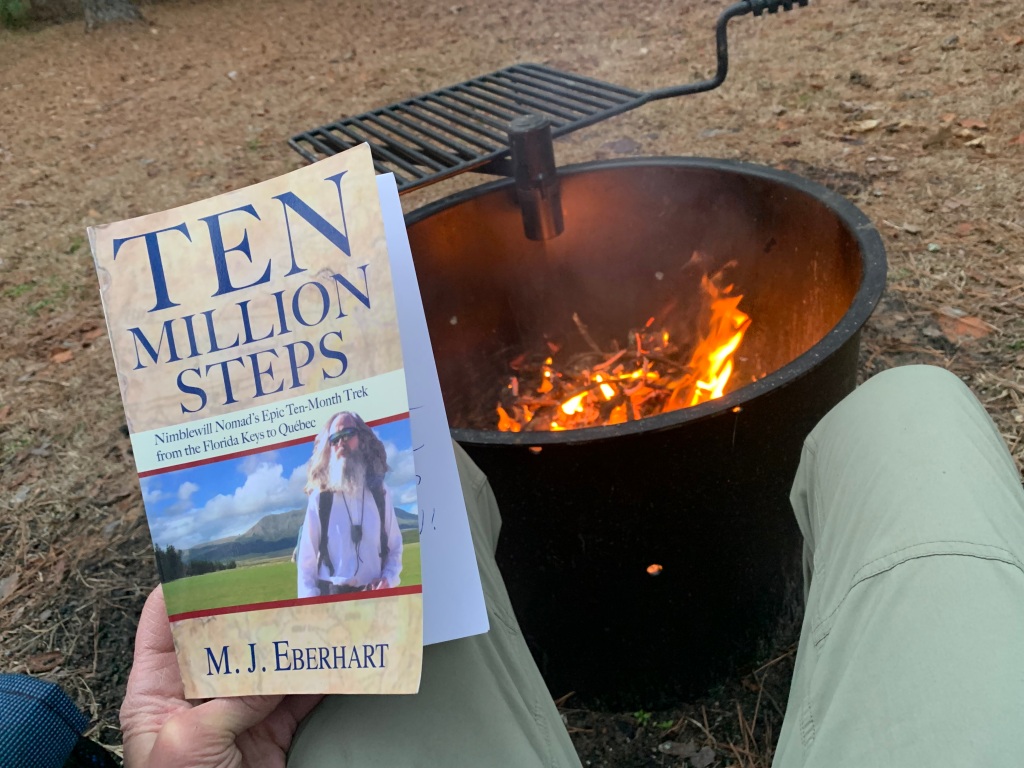
Nimblewill Nomad kept me company by the campfire on the warmer afternoons
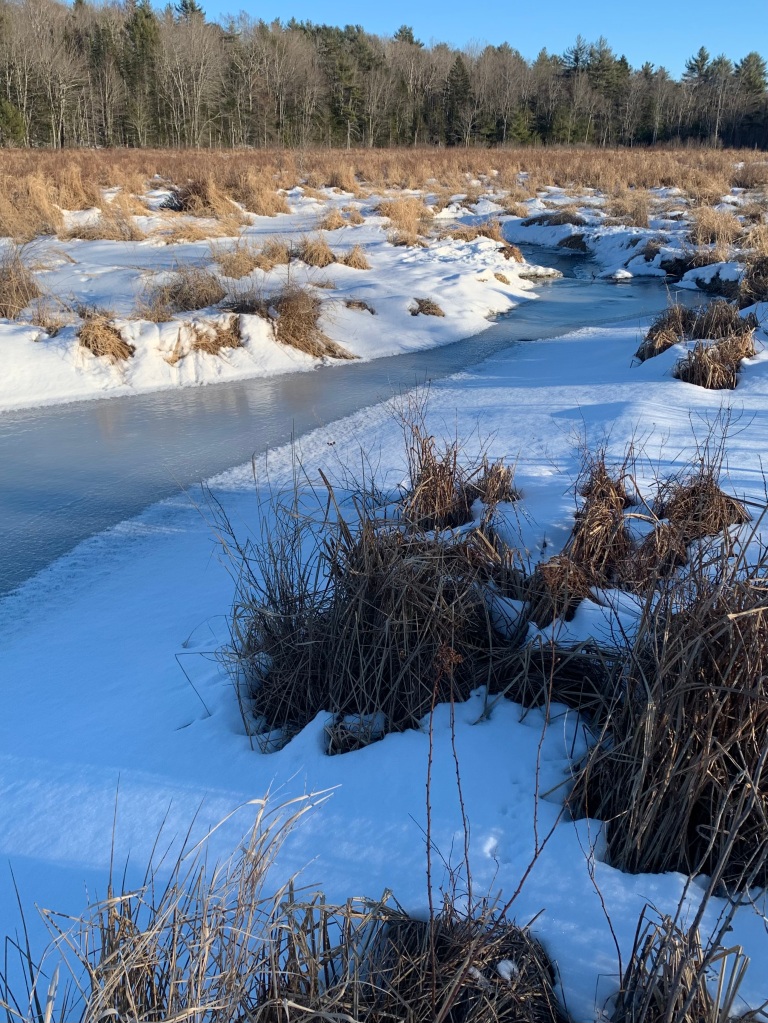
A more wintery walk a few days ago to the beaver swamp in our backwoods

Surprises of a quiet day: Blythe Island Regional Park, Brunswick, Georgia

A wildlife bonanza and kayaking serendipity right at camp

This campground, part of a park run by Glynn County, was my home for three nights, arriving January 23rd and departing January 26th. After the long excursion to Okefenokee, I decided to stay and enjoy the park on my last day. Chores and writing got accomplished, but I also just relaxed. While my laundry was drying in the laundromat, I walked over to the park’s public marina on the tidal South Brunswick River. The birds, there, oh my, I just couldn’t believe it!

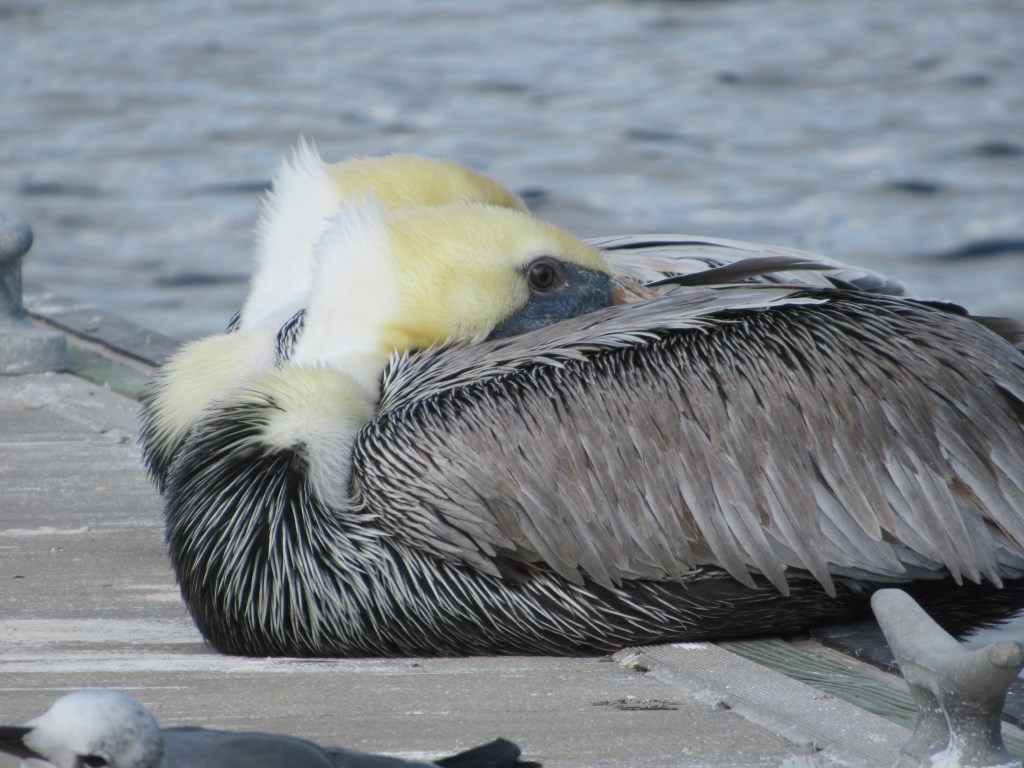
On the dock, a pair of brown pelicans posed willingly, their fuzzy yellow heads so soft in contrast to their much coarser gray body feathers, wet from the brackish water.
Another intriguing pose
A male hooded merganser popped up next. I watched him dive and preen, gazing down from behind a long fish cleaning table that mostly hid me from sight.
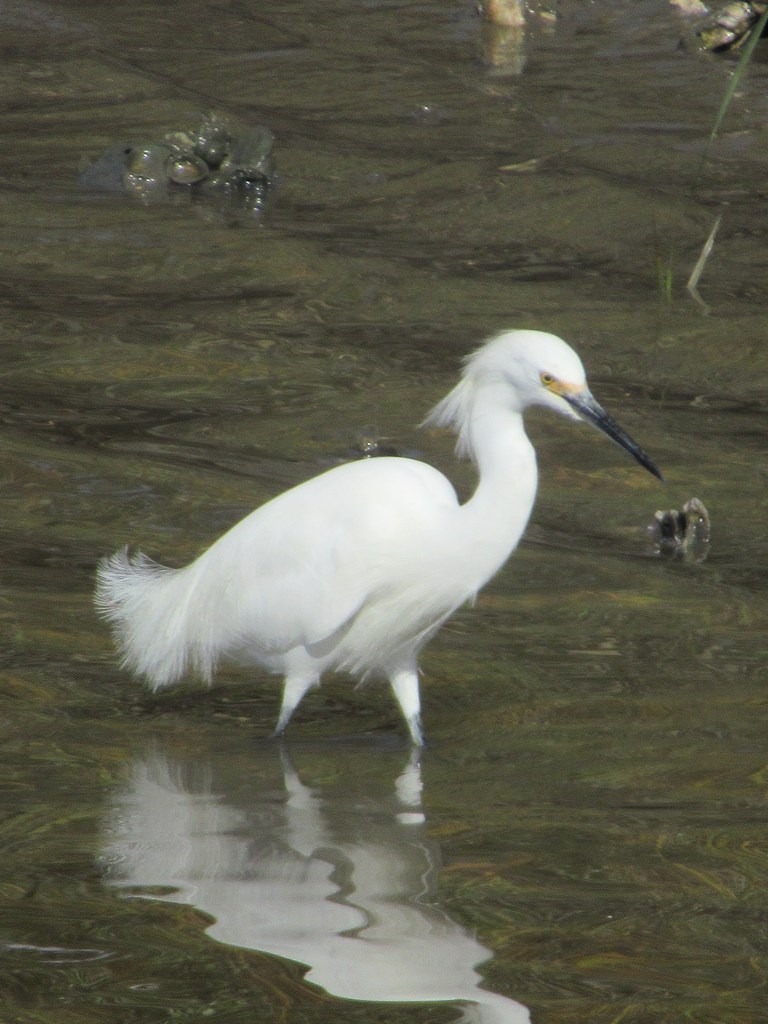
The snowy egret can be identified by its bright yellow feet, which I clearly saw as he stalked along.
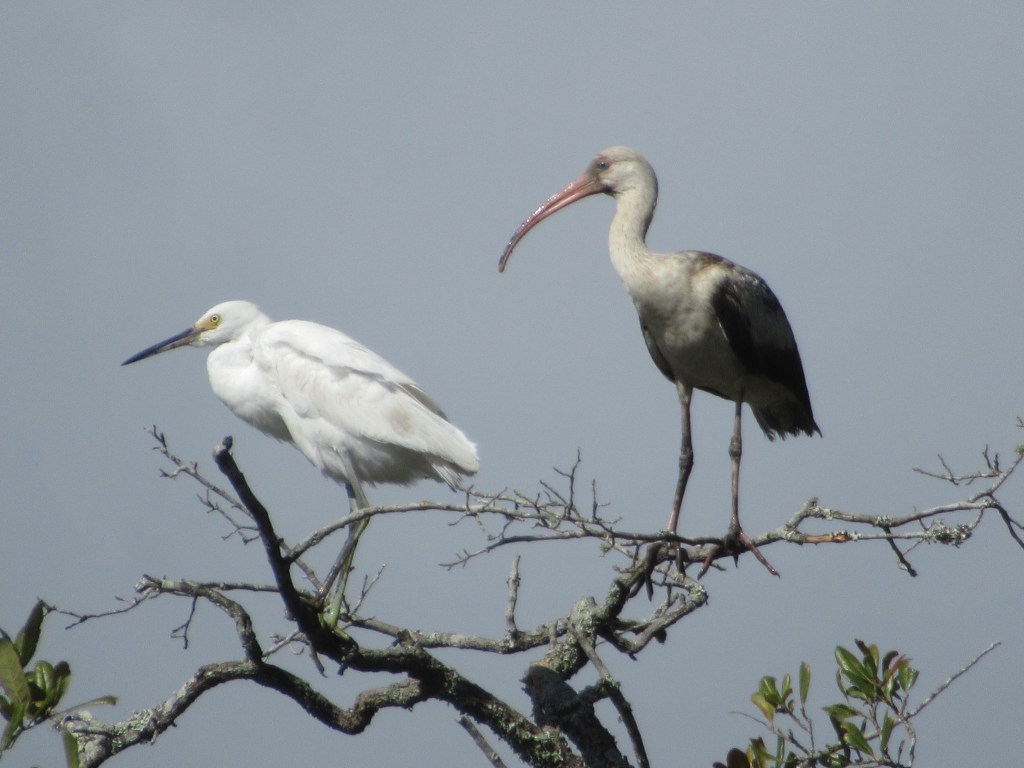
Then there were these buddies. The immature little blue heron on the left, with its distinctive green legs, flew in first. Then came the bird on the right, which I believe is an immature white ibis.
Two youngsters enjoying the hot sun and refreshing breeze, hanging out together.

Later that afternoon, I ambled out of my camp chair, assembled the kayak, and plopped it into the water that I could see from my front window. There are two tiny lakes there, but it turns out there is a canal (or stream?) that flows out the far side. Paddling past more egrets and a shy turtle, I followed the current into the narrow passage, past longleaf pine above and rhododendron below. Once, I turned back briefly just to make sure that going against the current would be doable.

If I hadn’t stayed to relax at camp, I would have missed this gem.
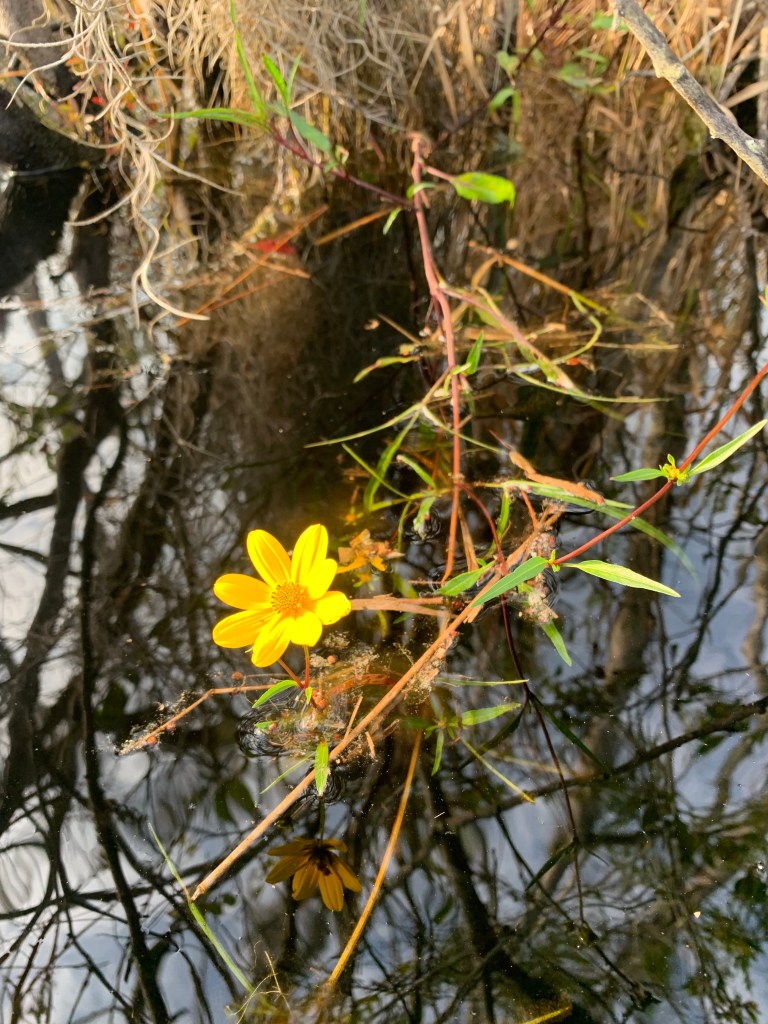
Today’s mystery water plant, observed in several large matted clumps

Exploring that canal and a couple of dead end turns off of it, I ended up paddling almost three miles. Meanwhile, there was a small problem in paradise. Fires ants! Carrying the kayak down, I had been bitten four times. I recognized that stinging pain right away, but it took a minute to find them under my Teva strap. A day later, my left foot would be swollen and very itchy, with blisters where the bites were and an ugly reddish color to the front half of my foot.

I will spare you a photo of that!

Last character of the day’s wildlife bonanza was this armadillo, spotted as I drove back home with a takeout shrimp po boy from Fish Tails Pub & Grill, right down the road.

Sometimes the best days happen right at home!

The alligators are out: Kayaking Okefenokee National Wildlife Refuge

Thrilling encounters with my first alligators while paddling my Oru folding kayak

Some stories need to be told right when they happen! Between North Carolina and here, I spent six nights off-grid in the Brick House campground in South Carolina’s Sumter National Forest. I’ll get back to that sojourn, which featured frigid temperatures, an ailing generator, and hiking the Palmetto Trail, later.

This 630-square-mile wildlife refuge includes the majority of the Okefenokee Swamp. The refuge’s main entrance is located off Route 121 in Folkston, Georgia.

Struggling to back my trailer in just where I wanted it was the perfect way to meet my backyard neighbors at the Blythe Island Regional Park campground in Brunswick, Georgia. Roy came over to quietly advise me and his wife Sue soon followed with information about some canoeing they’d been doing. The water trails at the wildlife refuge were a true discovery, and I knew I had to go explore them. Roy and Sue had seen and heard flocks of sandhill cranes and showed me photos of the Suwannee Canal, which begins at the visitor’s center.

Spanish moss drapes water-loving cypress along the shores of the 1891 canal

At the visitor’s center, I scooped up some fabulous free stickers for my growing collection and got an orientation to the water trails. As I had to be off the water by 4:30 p.m., I would do the length of the canal and back, around four miles, but would not get to explore any more of the water trail system.

How long has it been since I’ve seen a flower blooming?

The startling news was that lots of alligators had been seen basking in the sun on this 70-degree day! You think I’ll get to see one? I asked in surprise, as much excited as apprehensive. Oh, there’s no doubt, replied the ranger. He then assured me that alligators are not aggressive, and you can paddle to within fifteen feet to photograph them. Most of the time, in January, alligators are in brumation, a type of torpor where heart rate and metabolism slow down. On warmer days, though, when you start seeing turtles out, snakes and alligators will also be active.

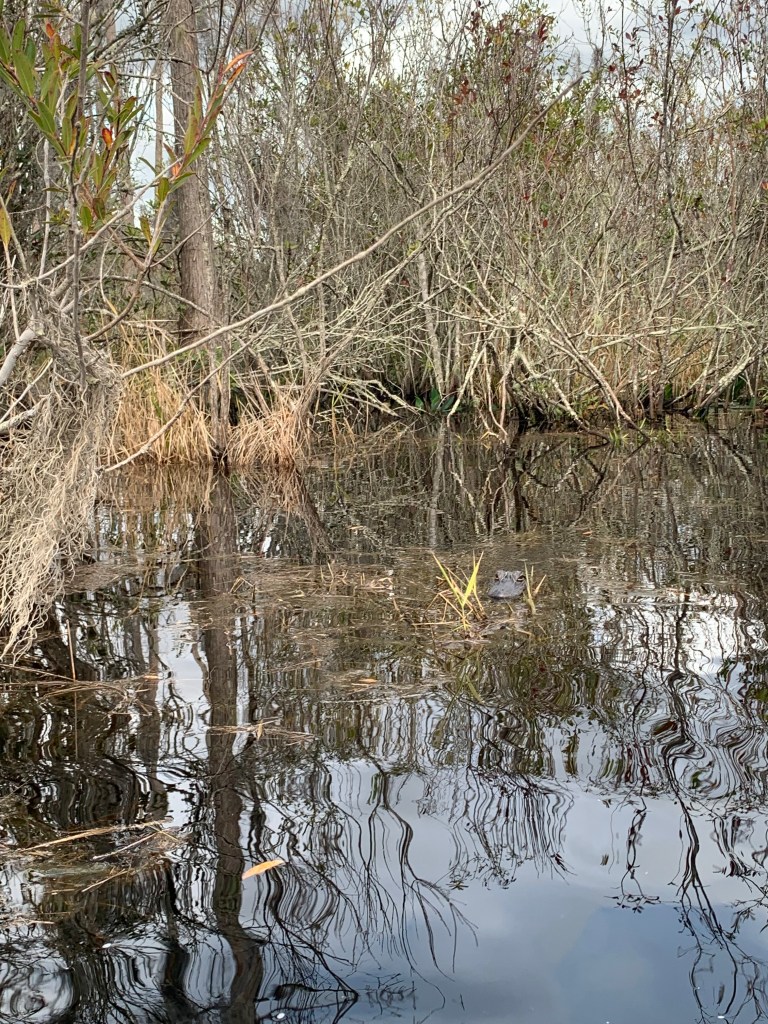
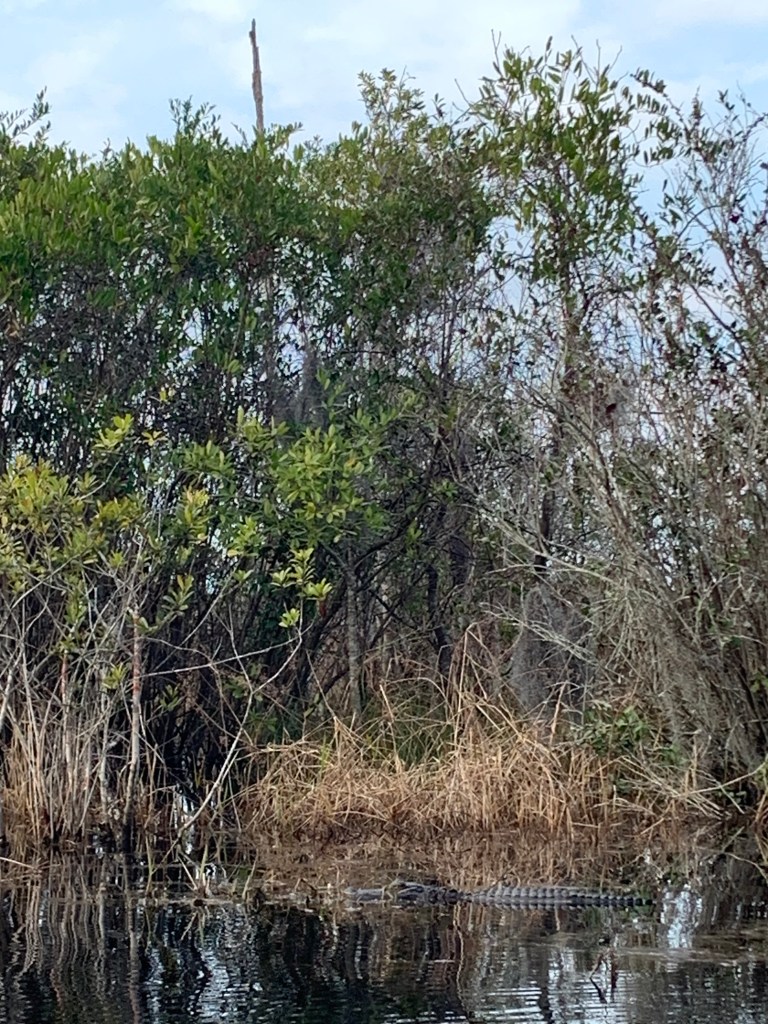
Every sense was on alert as I scanned the banks. In addition to reptiles, I was on the lookout for river otter or the elusive American bittern, both of which had been spotted today. The alligators would be sunning on the banks. I probed the tall dry grass and peered into the water under shrubby brush. Finally, a shape emerged, like jagged teeth…an alligator tail. It was a big one, and looking closely, I could see his body and head, facing away from me. The wind pushed me away, until trees hid his form. I paddled back again and again, not really believing that here I was in my little folding kayak communing with a gator!

Some of the big fellows were hard to spot. This one is tail first straight ahead of the kayak.

In two hours, I spotted eleven, four going out and seven coming back, so perhaps there were repeats. As I learned what to look for and where, they were easier to find. Two acknowledged my presence: a large one that slowly sank until only the top of his head and eyes were visible and a small one that twisted into the water with a big splash when I got too close. That was creepy, to have him somewhere underwater, not too far away!

Keeping an eye on each other!

My only regret was that I couldn’t stay longer and explore more. The refuge is home to flocks of white ibis and wood storks, as well at the sandhill cranes that Sue and Roy witnessed. Fifteen species of turtles make their home here. Perhaps someday I will return, to paddle farther and hike some of the trails as well.

Back on the water: Badin Lake, Uwharrie National Forest, NC

How my new origami kayak performed in some small coves on a very large lake

Every great blue heron seems unique. This one had marvelous feathers and a calm presence.

Before jumping into the report of kayaking Badin Lake in my new boat, I want to share that life out here is not always rosy. I’m in South Carolina now, and last night was cold, lonely, and edgy. A true test of camping totally off-grid in frigid conditions. I wanted to try this, and I’m discovering that a lot of effort goes into cleanliness (laundry and even showers, as the camper is still winterized) and maintaining enough battery power to have light and warmth. This morning, I woke to an outside temperature of 13, after a night in which I had to switch propane tanks at 2 a.m. and then lost battery power at 4:30 a.m., an hour and a half before generator use is allowed. But it’s warm and cheery in here now!

Assembling the kayak from folded suitcase to finished product is down to nine minutes

In asking for questions, it’s evident you want to know how the boat handles. My first two significant outings were on 5,350-acre Badin Lake, launching from the Cove Boat Ramp adjacent to my campground. After tying a line onto a bow strap, I stepped in from the dock. From the first moment, the boat felt very stable. A huge positive, along with its compact folded size, light weight, and portability. A boat that’s easy to get ready gets used more.

A friend has likened it to paddling a box, and in some respects, he is not far from the mark. I went out twice and found that my paddling technique improved with experience, as I adjusted to a much shorter, less dynamic craft, where I am not up on a seat. Even in small, choppy waves, I felt secure and angled into them as I would have in my canoe.

This was my favorite nook, where it almost seemed I would find a shortcut to the next cove. Maneuvering around logs and weeds, I was pleased that the boat responded in a familiar way.

Another drawback is comfort, or should I say discomfort? After a couple of hours on the thinly padded seat, I found myself wiggling and stretching to try to get comfortable. Loosening or tightening the side straps to adjust the angle of the seat’s back rest helps, but not enough. There is also no foot rest or bar to brace against. My back and bottom were very stiff when I clambered out onto the dock after the longer three-hour excursion.

Mosaic of sun and cloud above the beautiful wooded shore

Most of all, it just felt wonderful to be back out on the water. I saw lots of wildlife, including a painted turtle sunning in January, belted kingfisher, buffleheads, cormorants, herons, downy woodpecker, and a large dark hawk I could not identify. There were moments when the cadence of the paddle felt just like old times. Somehow, this seemed rather miraculous in this unique boat.

To read more about the sights on Badin Lake, look for my March column in the Northwoods Sporting Journal. Issues become available on the NSJ website shortly after publication.

Q&A: Pondering the journey so far

I thought you’d enjoy these answers, which are mostly to questions that I am asking myself, one month after leaving Maine. To write an honest and accurate book, it’s crucial to record thoughts and feelings as they grow and emerge during the course of a journey. So, here we go!

Unpacking some of my gifts in my parents’ apartment in Elizabethtown, Pennsylvania

What new gear and gadgets did you purchase for the trip?

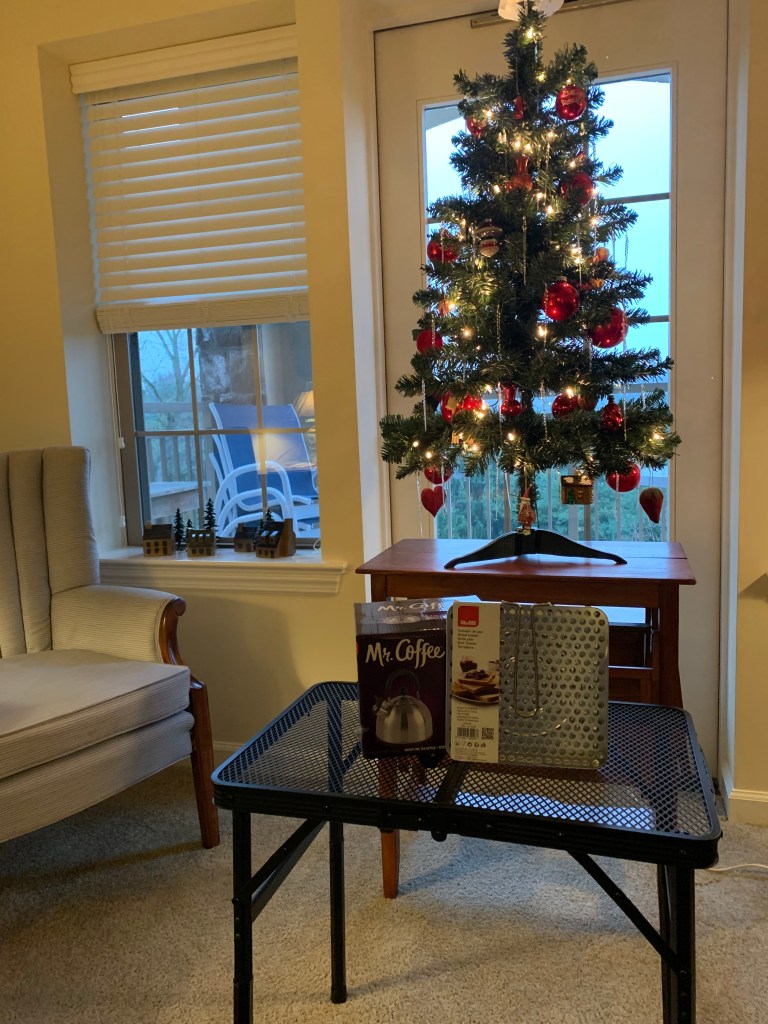
I acquired most of the “big” stuff (generator, solar panel and charge controller, ramp system for unloading the generator without killing myself, and all of the water, sewer, and electrical gear) last spring and early summer. I lived in the RV for several months in Maine last summer, off grid, and got to know and use it all. New for this journey were my Oru Lake kayak and a number of Christmas and birthday gifts: a new camp table, tea kettle (so I can cook in my one saucepan), toaster to use over a gas burner, and an immersion blender. I remember my Grandma Searls having a toaster like that, but hers looked like a tent and mine is flat with a heat diffuser on the bottom side. It works great! Thanks, Megan and Jacob and Taylor and Lizzy, for all the gifts!

Oh, my goodness, here’s Millie experiencing her first snow a few days ago.

What aspects of the trip have been harder or easier than you anticipated?

Let’s start with things I thought would be difficult but haven’t been. Hitching up the truck to the trailer and the whole process of camp set up and take down. My personal method is to keep hopping in and out to line up the ball with the hitch receiver and it’s gone great. I use a paper checklist for everything and check it faithfully, so as not to drive off with the stabilizer jacks down or anything else catastrophic. For the record, backing up into a site or for an unplanned turnaround also involves this hopping in and out, but it has proven to be every bit as difficult as I anticipated.

Another winner has been campground friendships, as I wrote about yesterday. At the crowded campground in Virginia last spring, people mostly seemed to be in large friend groups, and I had many a lonely evening. So, to discover Don and Joan and Al in North Carolina was a true blessing.

Lastly, my Verizon hotspot and cell phone plan (about $81 per month) has been fast and reliable so far, a necessity for efficient writing.

What’s been harder? Staying warm! I don’t need to tell any of you that we have been riding roller coaster waves of record cold. I bet I have at least five warm weather articles of clothing with me for every one cold weather garment. Thankfully, I brought an old wool Army blanket that belonged to Chris that has saved me many a night. Yes, I have a very efficient propane heater but a finite supply of propane and battery life (when not hooked up to electric). Last evening was the first comfortable one to linger by the campfire and read.

I am running over budget for fuel and camping costs, but this price found yesterday helped!

So, what have you been reading so far?

An ongoing read is The Rise and Reign of Mammals: A New History from the Shadow of the Dinosaurs to Us. (Megan always teases me about how long my book titles are. Here’s a rival!). This was a Christmas gift, too, and is engaging and successful in making a mammoth topic understandable to a non-paleontologist. I’ve already devoured Nevada Barr’s Winter Study, also a gift, and have mixed feelings about reading more of her terrifying and suspenseful mysteries set in national parks while camping alone!

I met Nimblewill Nomad at the 2019 International Appalachian Trail meeting and, for some reason, never got around to reading his book. Perhaps it was meant to be enjoyed around the campfire on this winter journey, as I may even end up walking some of the same trails.

Please send along any questions you may have for future Q&A posts, and congratulations if you spotted the pun!

Farewell snow, hello North Carolina

The Uwharrie National Forest offered excellent kayaking, hiking, and warm campground friendships at the start of my winter-long RV journey.

You have all been exceedingly patient in waiting for the full NC story, which will be covered in the next several posts. This was the first true camping stay of the trip, chosen for its convenience for a visit to my dad’s first cousin Janet in Graham, NC. I arrived on January 5, 2024, two days after my 62nd birthday. I had been eagerly anticipating this milestone, the magic age for purchasing a Senior Lifetime America the Beautiful pass.

Running from the snow and toward the Uwharrie National Forest headquarters before Friday closing time, I made it. After a marathon 484-mile drive, with my pass in hand, I set up in the Arrowhead Campground on Site #31 (first come, first serve so it was mine for up to 14 days). There was an electric hookup and a thankfully sturdy (more on that later!) stone shower house.
The Uwharrie National Forest is in Piedmont North Carolina, east of Charlotte.

At the campground, I found the community I had been promised. Don, the campground host, lives out his philosophy of making the world a better place, one camper at a time. He, and fellow campers Joan and Al, even bought my books! Joan, an AT section hiker who is well on her way to finishing, read as far as chapter 12 in Upwards, and it was fun to be able to answer her questions about my NFCT thru-paddle around the campfire.

How fortunate that Don was my first campground host! He finessed my trailer into a better spot for me, treated me to an El Dorado cheeseburger with onion rings, and stood next to my truck yesterday in the freezing cold and miraculously got it to start when it hadn’t earlier.
Me, with Al and Joan…a fun surprise was unexpectedly meeting them and their dog Missy, during my hike on the Dark Mt. trail!
Looking out from the shelter of the shower house during a downpour with a tornado warning!
My Arrowhead campsite (#31) was paved, fairly level, and very wide, with an electric hookup.
Looking toward the lake at sunset, with a glimpse of the lake through the trees.

History and a Hike: The Thornburg Tract, Birkhead Mountains Wilderness, NC

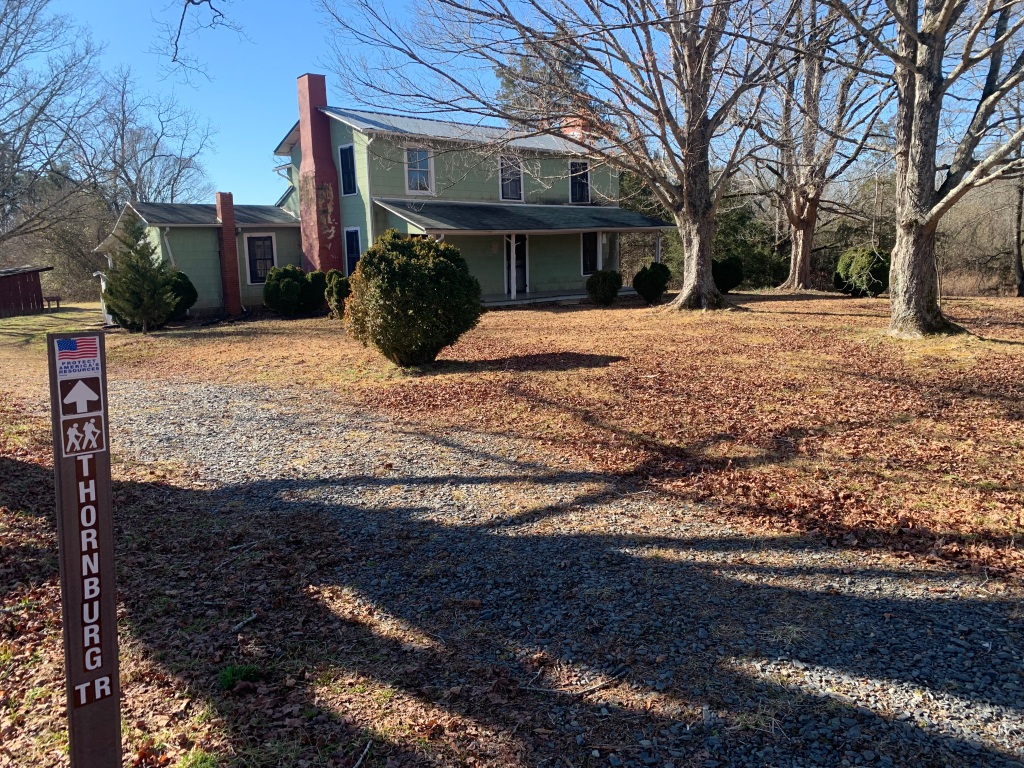
Winter hike and fun exploring the 1855 Lewis-Thornburg farmhouse and outbuildings

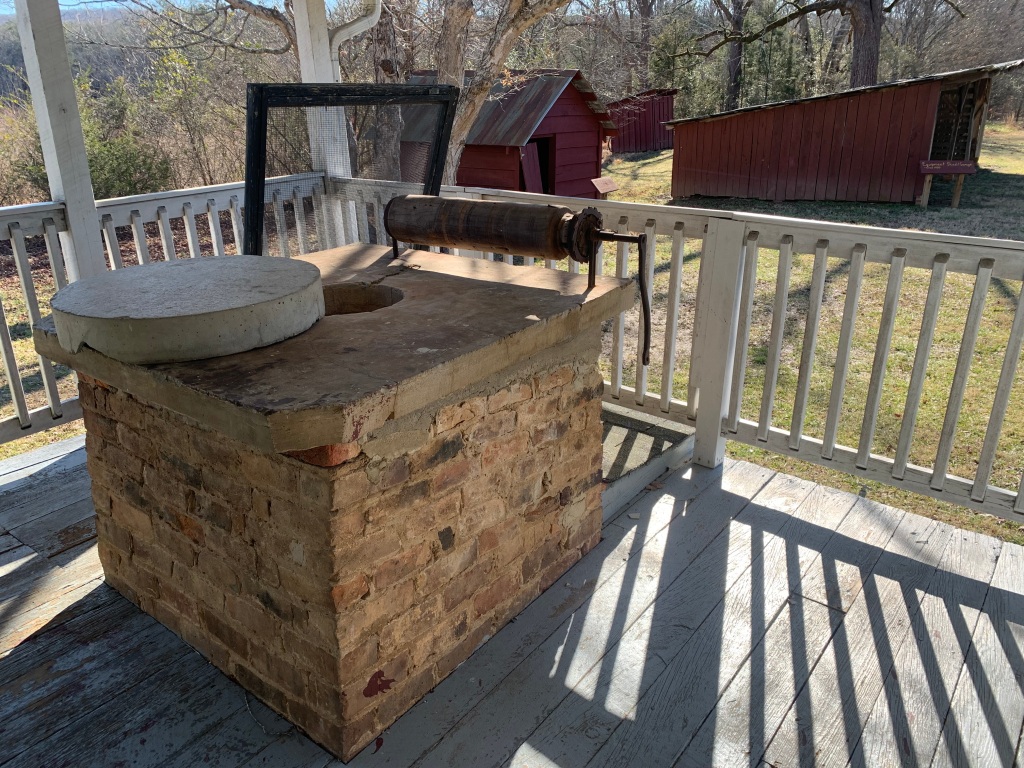
Back porch of the 1855 Lewis-Thornburg farmhouse

The Birkhead Mountains Wilderness is found at the northern tip of NC’s Uwharrie National Forest. Today’s exploration from the Thornburg trailhead included a 3.4-mile easy to moderate, although a little muddy, hike. The tract also includes what the kiosk eloquently describes as “an excellent example of the evolution of a vernacular farmhouse and outbuildings.”

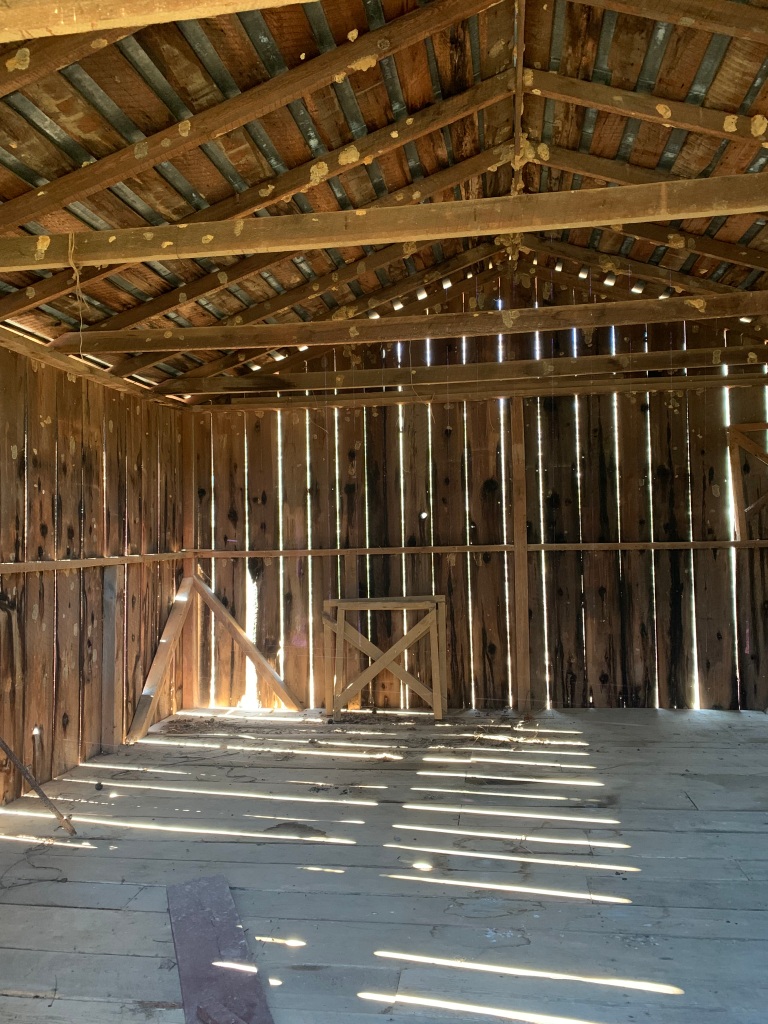
Behind the farmhouse and outbuildings (a barn, chicken house, carriage house, and tack shed) is the Thornburg Trail, a pleasant, rolling, up and down path through open hardwoods.

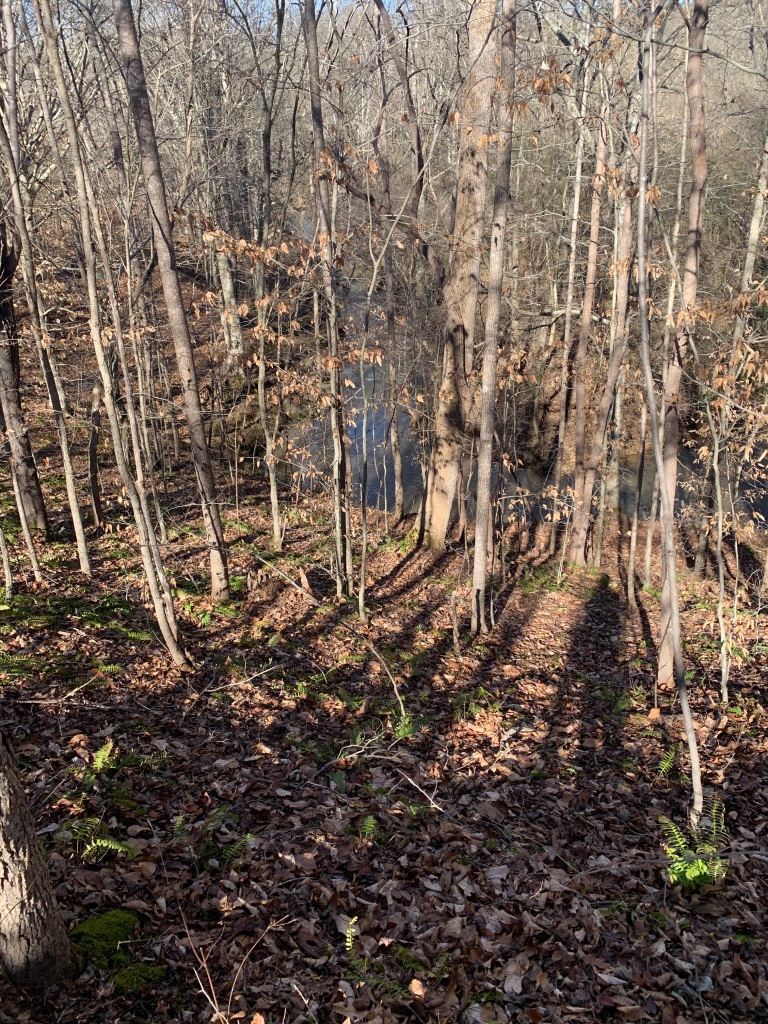
The temperature reluctantly climbed into the mid-50s today, warm enough to be comfortable moving along, even in the wind. I enjoyed plenty of friendly human and canine company along the way. The most interesting section of the trail looks down a steep hillside with lots of ferns to the stream below.

My shadow stretches toward the stream far below

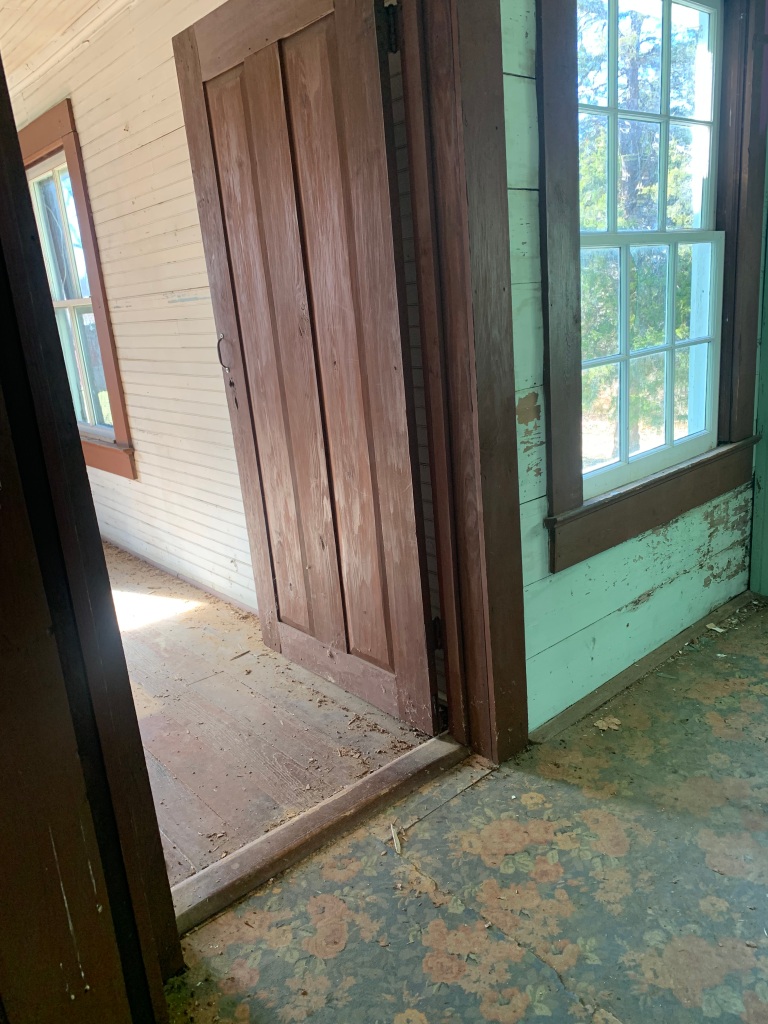
The Forest Service has preserved the farmhouse unfurnished and in need of some repairs, for visitors to explore. My favorite discoveries were the flowered linoleum patterns in the upstairs hall and bedrooms, as well as little handmade touches like hooks carved from tree branches.

Upstairs hall with flowered linoleum 
Sun drenching the interior of the carriage house, circa 1900.

Uwharrie National Recreational Trail: Dark Mt. and Little Long Mt.

Winter views and discoveries on two mountains along North Carolina’s Uwharrie National Recreational Trail

I want to begin with a note that my posts will not always appear in exact chronological order. In order to be a little more secure, I will be posting some details about my solo RV journey (like exact camping locations) after the fact. In the meantime, here’s a peek at yesterday’s adventure.

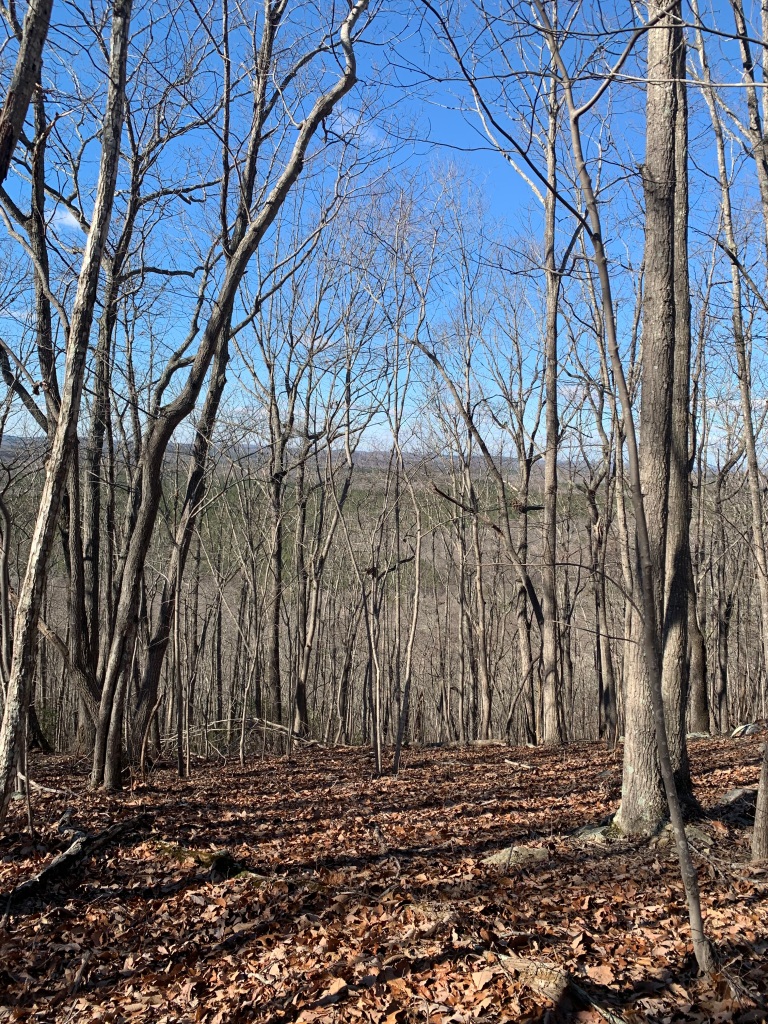
View from the shoulder of Dark Mountain near Mile 20

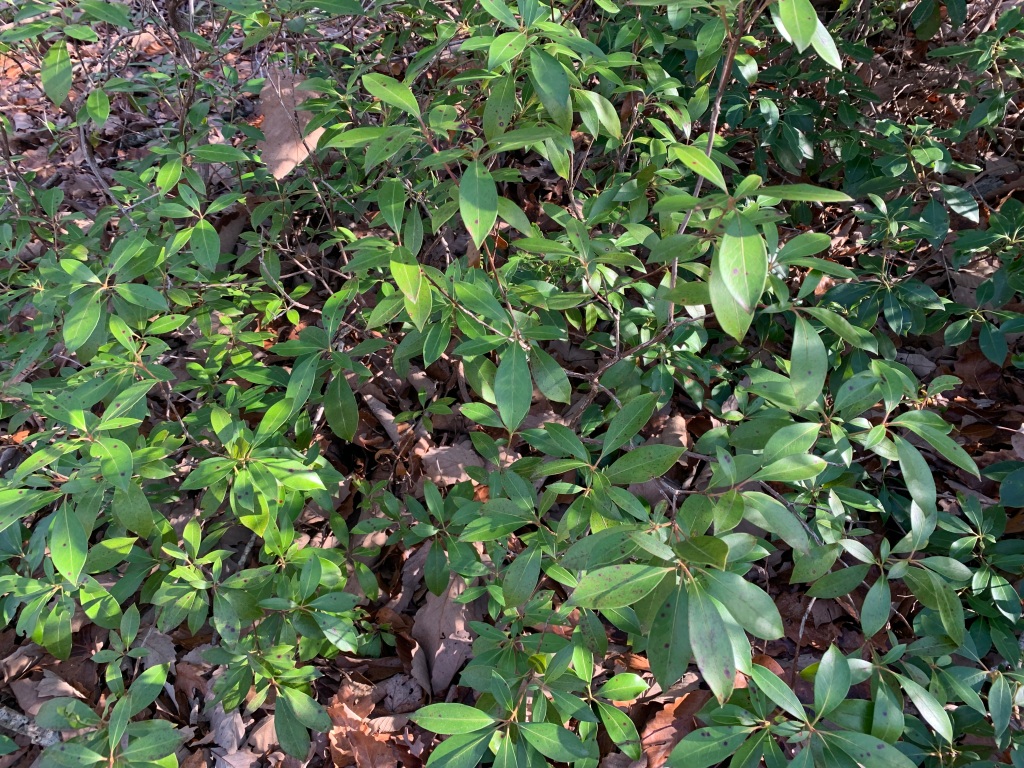
The 40-mile Uwharrie National Recreational Trail can be completed as a thru-hike or enjoyed in short sections. I began at the Jumping Off Rock trailhead, hiking south for the short, but rather steep, 500-foot ascent to the shoulder of Dark Mountain. Highlights were the beautiful open hardwood forest and patches of mountain laurel, which I could picture in its spring delicate, pink-flowered glory. Even in January, it was enlivening to see the shiny green.

Can you imagine the beauty of this mountainside in spring?

After the initial climb, the rest of the trail (4 miles roundtrip) was less rocky and smooth, with only gentle ups and downs. Wooden signs marked each mile, and surprisingly, there were audio stops where you could scan a QR code to listen to snippets of area history and ecology. The name Dark Mountain derives from tales of the killing of Army deserters here and an outlaw cave that was the hiding place for a murderer of one of those pesky revenuers.

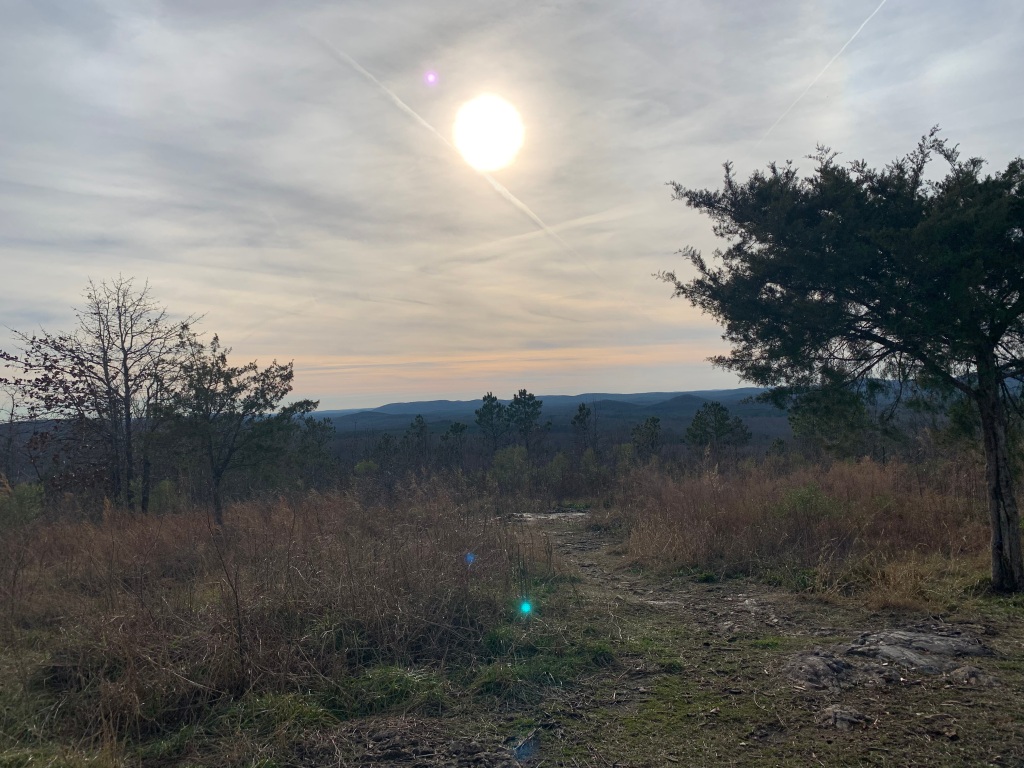
The summit of Little Long Mountain (922 ft) opens up to the best views of the day

Moving on to the nearby Joe Moffitt Trailhead, named for the Boy Scout leader who created the trail, I could choose between two hikes. To the north, King Mountain, the highest peak on the trail at 1,020 feet, was a 1.1-mile climb. To the south, Little Long Mountain was 0.8 miles away and provided the most open mountaintop vistas. I went south, hiking back toward Dark Mountain.

Passing through a short section of copious exposed white granite

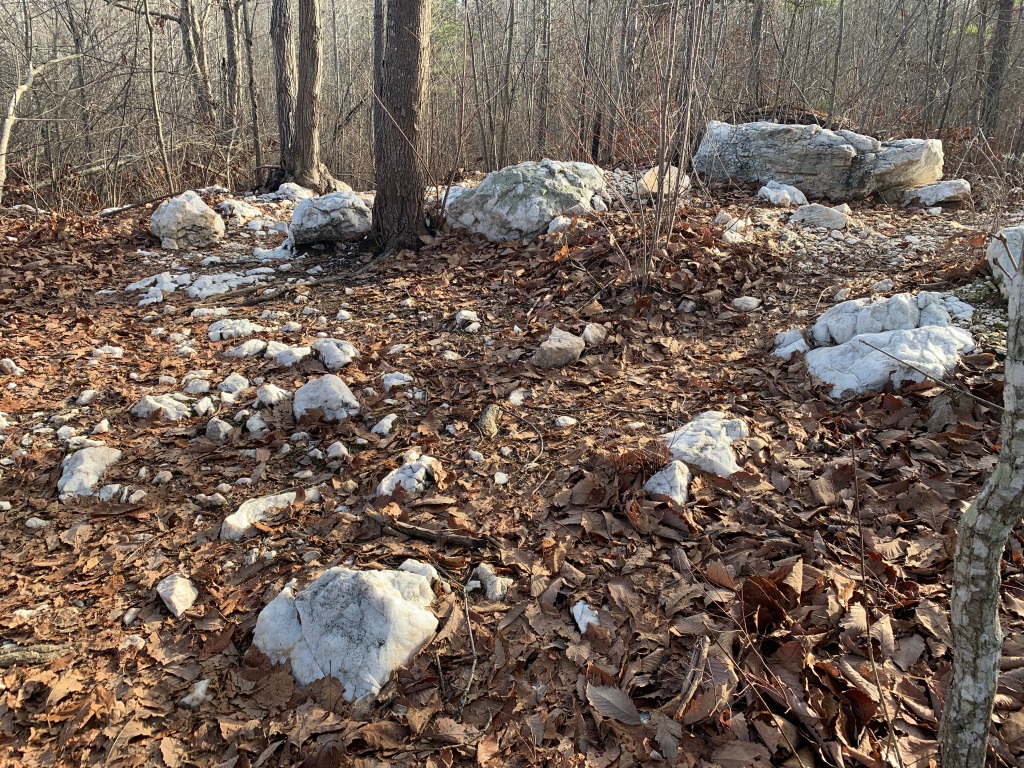
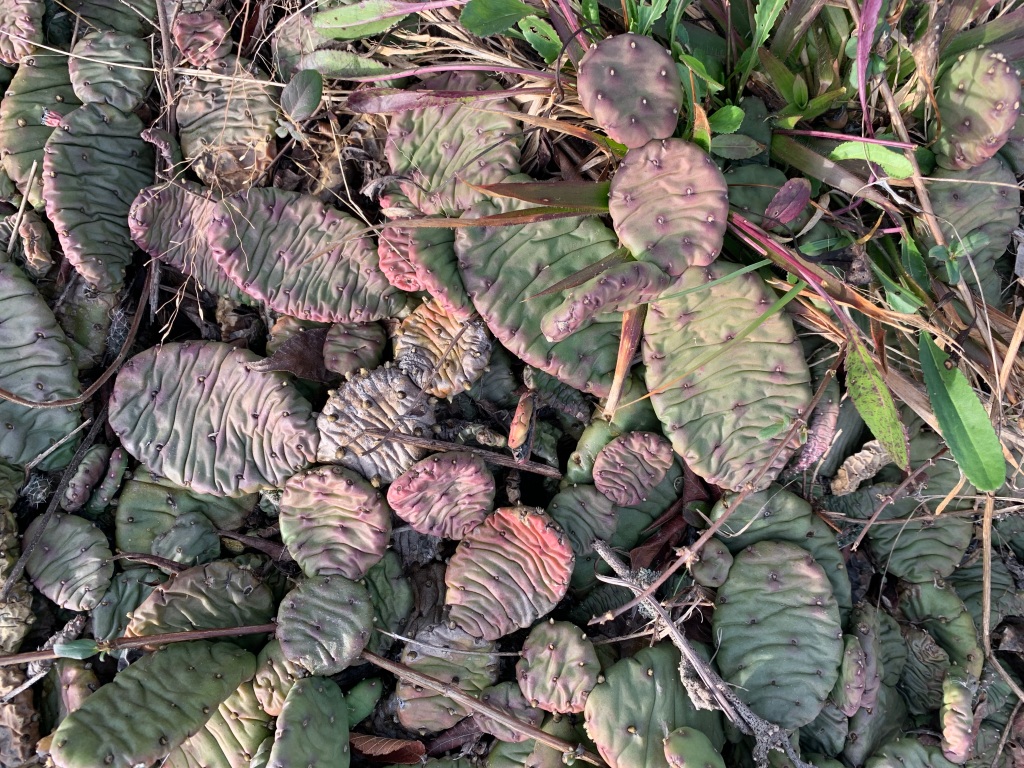
At the Little Long Mountain summit, another audio tour stop explained that I was standing in a Piedmont glade. Characterized by thin layers of soil over rock, this ecological community features unique plant species like native prickly pear cactus (Opuntia humifusa), which I found in abundance. There is a lean-to here, as well as a spring providing a water source on the way up. Descending, my first white-tailed deer of the Uwharrie bounded away down the hillside.

My new origami kayak

Introducing the new, lightweight, folding Oru Kayak that’s joining me on my winter RV travels in the South

At first, I planned to bring my 13-foot solo canoe along on this winter’s RV travels. The more I thought about it, though, the more I wished for a more compact boat. Well, it doesn’t get much more compact than a folding kayak. Folded up, it resembles a suitcase, complete with handle. It fits easily inside the truck’s back seat area. You can even fly with it as luggage!

My Lake model Oru Kayak at Maine’s Biscay Pond after its first short outing

Made in the USA, Oru kayaks come with a 3-year warranty. The material they are made of reminds me of post office mail tubs. The 5-mm, double-layered, polypropylene sheet is not flat. The bow and stern are partially shaped and have small hard plastic caps. The boat comes with pre-marked fold lines, but getting it assembled the first time was not an easy task. Even now, considerable effort and force are needed to pop the folds in and out.

Awfully chilly on my bare feet getting in and out on a Maine lake on December 15th!

As I travel South, the waters will be warmer and the excursions longer. My kayak, the Lake model, is the newest, lightest (18 pounds), and plainest of the Oru kayaks. It is easy to carry, ensuring that I will use it often.

There are still uncertainties ahead. How will it track and handle in wind and waves? Will it always feel as stable as it did when I hopped in the first time? Dare I paddle it where there are alligators? All this and more will be answered in the coming days and months.

To learn more, look for my column, “View from the River,” in the upcoming February issue of the Northwoods Sporting Journal. It’s all about the boat.